Ch. 4 - Acids and Bases: Electron Flow
Mullins - Organic Chemistry: A Learner Centered Approach 1st Edition
Mullins1st EditionOrganic Chemistry: A Learner Centered ApproachISBN: 9780137566471Not the one you use?Change textbook
Chapter 3, Problem 22b

Given the value of Keq for the following acid–base reactions, identify the weakest acid and the weakest base.
(b) Chemical reaction diagram showing acid-base equilibrium with Keq value of 10^6, illustrating reactants and products.

Verified step by step guidance
1
Step 1: Analyze the reaction provided. The reaction involves ethyllithium (H₃C–CH₂Li) reacting with water (H₂O) to produce ethane (H₃C–CH₃) and lithium hydroxide (HO⁻Li⁺). The equilibrium constant (K_eq) is given as 2.0 × 10⁴⁴, which is extremely large, indicating the reaction strongly favors the products.
Step 2: Recall the relationship between acid strength and conjugate base strength. A strong acid has a weak conjugate base, and a weak acid has a strong conjugate base. Similarly, a strong base has a weak conjugate acid, and a weak base has a strong conjugate acid.
Step 3: Identify the acids and bases in the reaction. In this case, ethyllithium acts as the base, and water acts as the acid. On the product side, ethane is the conjugate acid of ethyllithium, and lithium hydroxide is the conjugate base of water.
Step 4: Use the K_eq value to determine the relative strengths. Since K_eq is extremely large, the reaction strongly favors the formation of ethane and lithium hydroxide. This implies that ethane is a very weak acid and lithium hydroxide is a very weak base compared to their counterparts on the reactant side.
Step 5: Conclude that the weakest acid in the reaction is ethane (H₃C–CH₃), and the weakest base in the reaction is lithium hydroxide (HO⁻Li⁺).

Verified video answer for a similar problem:

This video solution was recommended by our tutors as helpful for the problem above.
Video duration:
4m
Was this helpful?

Key Concepts

Here are the essential concepts you must grasp in order to answer the question correctly.

Equilibrium Constant (K_eq)

The equilibrium constant (K_eq) quantifies the ratio of the concentrations of products to reactants at equilibrium for a given reaction. A large K_eq value, such as 2.0 x 10^44, indicates that the products are favored, suggesting that the reaction proceeds almost to completion. This concept is crucial for determining the strength of acids and bases in a reaction.
Recommended video:
Guided course
02:19
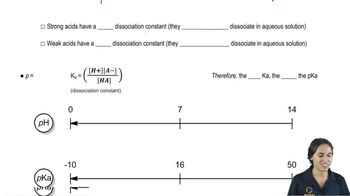
The relationship between equilibrium constant and pKa.

Acid-Base Strength

Acid-base strength is determined by the ability of an acid to donate protons (H+) and a base to accept protons. In a reaction, the weaker acid corresponds to the stronger base, as the equilibrium favors the formation of the weaker acid and base. Understanding this relationship is essential for identifying the weakest acid and base in the given reaction.
Recommended video:
2:50
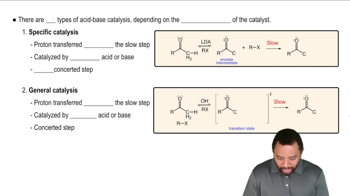
Acid-Base Catalysis Concept 3

Reaction Products

In acid-base reactions, the products formed can provide insight into the relative strengths of the reactants. For instance, in the reaction shown, ethane and lithium hydroxide are produced, indicating that ethyllithium acts as a strong base and water as a weak acid. Analyzing the products helps in determining which reactant is the weakest acid and base.
Recommended video:
Guided course
11:07
Bridged-Products