Ch. 4 - Acids and Bases: Electron Flow
Mullins - Organic Chemistry: A Learner Centered Approach 1st Edition
Mullins1st EditionOrganic Chemistry: A Learner Centered ApproachISBN: 9780137566471Not the one you use?Change textbook
Chapter 3, Problem 7b

Sodium amide (NaNH₂) dissociates to give a sodium cation (Na+) and amide ion (NH2) a very strong base. In the following three equations, identify which definition of base is being exemplified.
(b)

Verified step by step guidance
1
Step 1: Analyze the chemical equation provided. Sodium amide (NaNH₂) reacts with water (H₂O) to produce hydroxide ion (OH⁻), sodium ion (Na⁺), and ammonia (NH₃).
Step 2: Recognize the role of NaNH₂ in the reaction. The amide ion (NH₂⁻) acts as a base by accepting a proton (H⁺) from water, forming NH₃.
Step 3: Identify the definition of a base being exemplified. According to the Brønsted-Lowry definition, a base is a substance that accepts a proton. Here, NH₂⁻ accepts a proton from H₂O, demonstrating the Brønsted-Lowry base behavior.
Step 4: Note the products formed. The hydroxide ion (OH⁻) is left behind after water donates a proton, and ammonia (NH₃) is formed as a result of NH₂⁻ accepting the proton.
Step 5: Conclude that the reaction exemplifies the Brønsted-Lowry definition of a base, as the amide ion (NH₂⁻) acts as a proton acceptor.

Verified video answer for a similar problem:

This video solution was recommended by our tutors as helpful for the problem above.
Was this helpful?

Key Concepts

Here are the essential concepts you must grasp in order to answer the question correctly.

Brønsted-Lowry Base

A Brønsted-Lowry base is defined as a substance that can accept protons (H⁺ ions) in a chemical reaction. This concept emphasizes the role of bases in proton transfer processes, distinguishing them from other definitions that may focus solely on hydroxide ion production. In the context of sodium amide, the amide ion (NH₂⁻) acts as a Brønsted-Lowry base by accepting protons from acids.
Recommended video:
Guided course
00:54
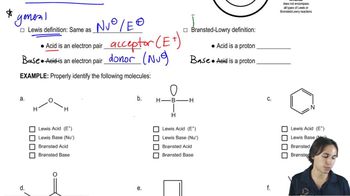
The Bronsted-Lowry definition of acids and bases.

Lewis Base

A Lewis base is defined as an electron pair donor in a chemical reaction. This definition broadens the concept of basicity beyond proton acceptance to include any species that can donate a pair of electrons to form a covalent bond. Sodium amide, through its amide ion, can act as a Lewis base by donating its lone pair of electrons to electrophiles.
Recommended video:
Guided course
02:49
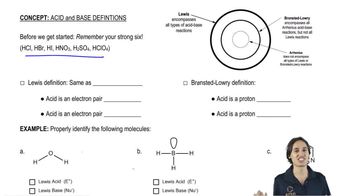
The Lewis definition of acids and bases.

Strong Base

A strong base is a substance that completely dissociates in solution to produce hydroxide ions or other strong basic species. Sodium amide is classified as a strong base because it dissociates fully in water to yield sodium cations and amide ions, which are highly reactive and capable of deprotonating weak acids, thus demonstrating strong basic behavior.
Recommended video:
Guided course
03:10
Monosaccharides - Strong Oxidation (Aldaric Acid)