Ch. 4 - Acids and Bases: Electron Flow
Mullins - Organic Chemistry: A Learner Centered Approach 1st Edition
Mullins1st EditionOrganic Chemistry: A Learner Centered ApproachISBN: 9780137566471Not the one you use?Change textbook
Chapter 3, Problem 10d

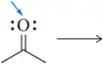
What is the conjugate acid of each of the following bases? [The most basic atom is indicated.]
(d) Diagram showing a basic atom with an arrow indicating the conjugate acid formation from a base.

Verified step by step guidance
1
Identify the base provided in the problem. A base is a species that can accept a proton (H⁺). The most basic atom in the molecule is the one most likely to accept the proton.
Recall the definition of a conjugate acid: When a base accepts a proton (H⁺), it forms its conjugate acid. This involves adding an H⁺ to the most basic atom in the base.
Determine the structure of the conjugate acid by adding an H⁺ to the most basic atom. This may involve adjusting the formal charge of the atom that accepts the proton. For example, if the atom is neutral before accepting the proton, it will become positively charged after.
Write the chemical formula or structure of the conjugate acid, ensuring that the added H⁺ is correctly placed and the formal charges are updated.
Double-check the result to ensure that the conjugate acid is correctly derived from the base and that the most basic atom has been protonated.

Verified video answer for a similar problem:

This video solution was recommended by our tutors as helpful for the problem above.
Video duration:
3m
Was this helpful?

Key Concepts

Here are the essential concepts you must grasp in order to answer the question correctly.

Conjugate Acid-Base Theory

In acid-base chemistry, a conjugate acid is formed when a base accepts a proton (H+). This concept is central to understanding the relationship between acids and bases, where every base has a corresponding conjugate acid. For example, when ammonia (NH3) acts as a base and accepts a proton, it becomes ammonium (NH4+), its conjugate acid.
Recommended video:
Guided course
02:11
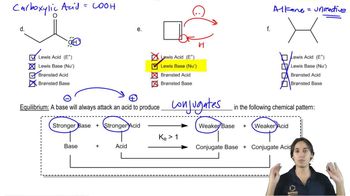
Equilibrium constant and conjugates.

Basicity and pKa

Basicity refers to the ability of a substance to accept protons, and it is often quantified by the pKa value of its conjugate acid. A lower pKa indicates a stronger acid, which corresponds to a weaker base. Understanding the pKa values helps predict the strength of bases and their corresponding conjugate acids, aiding in identifying the correct conjugate acid for a given base.
Recommended video:
Guided course
07:45
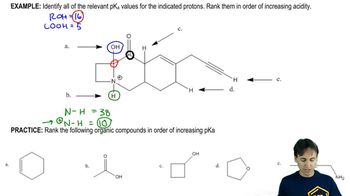
Identifying pKa values

Proton Transfer Reactions

Proton transfer reactions are fundamental in acid-base chemistry, where the transfer of a proton from an acid to a base occurs. This process is essential for determining the conjugate acid of a base. Recognizing the most basic atom in a molecule helps identify where the proton transfer will occur, leading to the formation of the conjugate acid.
Recommended video:
Guided course
03:
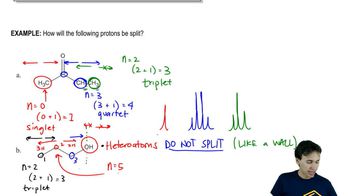
Proton Splitting