Ch. 5 - Chemical Reaction Analysis: Thermodynamics and Kinetics
Mullins - Organic Chemistry: A Learner Centered Approach 1st Edition
Mullins1st EditionOrganic Chemistry: A Learner Centered ApproachISBN: 9780137566471Not the one you use?Change textbook
Chapter 4, Problem 18b

For each of the following processes, indicate whether you expect ∆S° to be greater than, less than, or equal to 0. Explain your answer.
(b) 2 C6H14(l) + 19 O2(g) → 12 CO2(g) + 14 H2O(g)

Verified step by step guidance
1
Step 1: Understand the concept of entropy (∆S°). Entropy is a measure of the disorder or randomness in a system. A positive ∆S° indicates an increase in disorder, while a negative ∆S° indicates a decrease in disorder.
Step 2: Analyze the reactants and products in the given reaction. The reactants are 2 molecules of liquid hexane (C₆H₁₄) and 19 molecules of gaseous oxygen (O₂). The products are 12 molecules of gaseous carbon dioxide (CO₂) and 14 molecules of gaseous water (H₂O).
Step 3: Compare the physical states of the reactants and products. Liquids generally have lower entropy than gases because gases are more disordered. In this reaction, the liquid reactants (C₆H₁₄) are converted into gaseous products (CO₂ and H₂O), which suggests an increase in entropy.
Step 4: Count the total number of gas molecules on each side of the reaction. On the reactant side, there are 19 molecules of O₂ gas. On the product side, there are 12 molecules of CO₂ gas and 14 molecules of H₂O gas, for a total of 26 gas molecules. Since the number of gas molecules increases, this also suggests an increase in entropy.
Step 5: Conclude that ∆S° is expected to be greater than 0 for this reaction because the system transitions from a state with fewer gas molecules and some liquid molecules to a state with more gas molecules, indicating an increase in disorder.

Verified video answer for a similar problem:

This video solution was recommended by our tutors as helpful for the problem above.
Was this helpful?

Key Concepts

Here are the essential concepts you must grasp in order to answer the question correctly.

Entropy (∆S°)

Entropy, denoted as ∆S°, is a measure of the disorder or randomness in a system. In chemical reactions, changes in entropy can indicate whether the products are more or less disordered than the reactants. A positive ∆S° suggests an increase in disorder, while a negative ∆S° indicates a decrease.
Recommended video:
Guided course
02:46
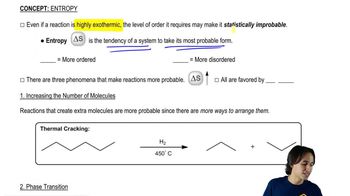
Explaining what entropy is.

Phase Changes and Gaseous Products

The phase of substances significantly affects entropy. Gases have higher entropy than liquids or solids due to their greater freedom of movement and higher disorder. In the given reaction, the formation of gaseous products (CO₂ and H₂O) from liquid reactants (C₆H₁₄) suggests an increase in entropy.
Recommended video:
1:53
Merrifield Solid-Phase Peptide Synthesis Concept 1

Stoichiometry and Reaction Direction

Stoichiometry involves the quantitative relationships between reactants and products in a chemical reaction. In this reaction, the conversion of 2 moles of liquid C₆H₁₄ and 19 moles of gaseous O₂ into 12 moles of gaseous CO₂ and 14 moles of gaseous H₂O indicates a net increase in the number of gas molecules, which typically correlates with a positive change in entropy.
Recommended video:
Guided course
02:19
Directed Condensations