Ch. 5 - Chemical Reaction Analysis: Thermodynamics and Kinetics
Mullins - Organic Chemistry: A Learner Centered Approach 1st Edition
Mullins1st EditionOrganic Chemistry: A Learner Centered ApproachISBN: 9780137566471Not the one you use?Change textbook
Chapter 4, Problem 24c

For the following acid–base reaction, (c) calculate the ratio of butan-2-ol to 2-butoxide.

Verified step by step guidance
1
Step 1: Identify the acid and base in the reaction. Butan-2-ol acts as the acid, and 2-butoxide acts as the conjugate base. This is an acid–base equilibrium reaction.
Step 2: Determine the pKa value of butan-2-ol. The pKa is a measure of the strength of the acid, and it is essential for calculating the equilibrium constant. Look up the pKa value in a reliable reference source.
Step 3: Use the Henderson-Hasselbalch equation to calculate the ratio of the acid (butan-2-ol) to its conjugate base (2-butoxide). The equation is: pH=pKa+log([A-][HA]), where [HA] is the concentration of butan-2-ol and [A⁻] is the concentration of 2-butoxide.
Step 4: Rearrange the Henderson-Hasselbalch equation to solve for the ratio of [HA] to [A⁻]. The ratio can be expressed as: [HA][A-]=10(pKa-pH). This step requires knowing the pH of the solution.
Step 5: Plug in the values for pKa and pH into the equation to calculate the ratio. Ensure that the pH of the solution is provided or determined experimentally. The final ratio will indicate the relative concentrations of butan-2-ol and 2-butoxide in the equilibrium mixture.

Verified video answer for a similar problem:

This video solution was recommended by our tutors as helpful for the problem above.
Video duration:
7m
Was this helpful?

Key Concepts

Here are the essential concepts you must grasp in order to answer the question correctly.

Acid-Base Reactions

Acid-base reactions involve the transfer of protons (H+) between reactants. In organic chemistry, acids are proton donors, while bases are proton acceptors. Understanding the nature of the acids and bases involved is crucial for predicting the products and calculating equilibrium constants in these reactions.
Recommended video:
Guided course
02:49
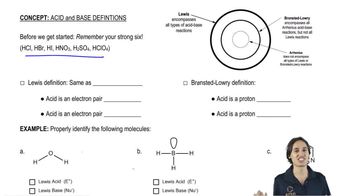
The Lewis definition of acids and bases.

Alcohols and Alkoxides

Butan-2-ol is a secondary alcohol, which can act as a weak acid, while 2-butoxide is its corresponding alkoxide, formed when the alcohol loses a proton. The relationship between alcohols and their alkoxide counterparts is essential for understanding their reactivity and the equilibrium established in acid-base reactions.
Recommended video:
Guided course
01:01
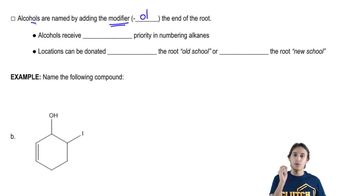
How to name alcohols

Equilibrium and Ratios

In acid-base reactions, the equilibrium constant (K) can be used to determine the ratio of products to reactants at equilibrium. This ratio is critical for calculating the concentrations of butan-2-ol and 2-butoxide in the reaction, allowing for a quantitative understanding of the reaction dynamics and the extent of proton transfer.
Recommended video:
Guided course
02:19
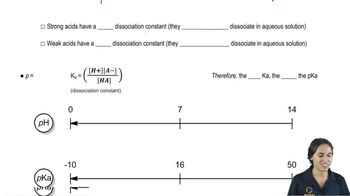
The relationship between equilibrium constant and pKa.