Ch. 5 - Chemical Reaction Analysis: Thermodynamics and Kinetics
Mullins - Organic Chemistry: A Learner Centered Approach 1st Edition
Mullins1st EditionOrganic Chemistry: A Learner Centered ApproachISBN: 9780137566471Not the one you use?Change textbook
Chapter 4, Problem 11c

For the following values of ∆H° , ∆S°, and T, tell whether the process would be favored.
(c) ∆H° = -21.3 kcal/mol ; AS° = -51 cal/mol•K ; T = 373 K

Verified step by step guidance
1
Step 1: Recall the Gibbs free energy equation: ΔG° = ΔH° - TΔS°. This equation determines whether a process is thermodynamically favored. A negative value of ΔG° indicates a favored process.
Step 2: Ensure the units of ΔH° and ΔS° are consistent. Here, ΔH° is given in kcal/mol, and ΔS° is in cal/mol•K. Convert ΔH° to cal/mol by multiplying by 1000: ΔH° = -21.3 imes 1000 = -21300 \(\text{ cal/mol}\).
Step 3: Substitute the given values into the Gibbs free energy equation: ΔG° = (-21300) - (373)(-51). Be careful with the negative sign in ΔS°.
Step 4: Simplify the equation by calculating the term TΔS°. Multiply the temperature (373 K) by ΔS° (-51 cal/mol•K): TΔS° = 373 imes -51. Then, subtract this value from ΔH°.
Step 5: Analyze the sign of the resulting ΔG°. If ΔG° is negative, the process is thermodynamically favored. If it is positive, the process is not favored.

Verified video answer for a similar problem:

This video solution was recommended by our tutors as helpful for the problem above.
Video duration:
4m
Was this helpful?

Key Concepts

Here are the essential concepts you must grasp in order to answer the question correctly.

Gibbs Free Energy

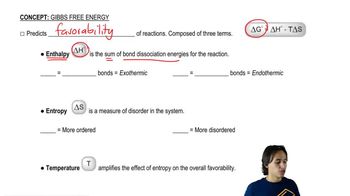
Gibbs Free Energy (G) is a thermodynamic potential that helps predict whether a process will occur spontaneously at constant temperature and pressure. It is calculated using the formula ΔG = ΔH - TΔS, where ΔH is the change in enthalpy, T is the temperature in Kelvin, and ΔS is the change in entropy. A negative ΔG indicates that the process is favored, while a positive ΔG suggests it is not.
Recommended video:
Guided course
05:02
Breaking down the different terms of the Gibbs Free Energy equation.

Enthalpy (ΔH)

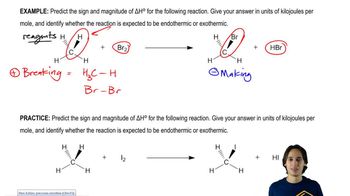
Enthalpy (ΔH) is a measure of the total heat content of a system. A negative ΔH value, such as -21.3 kcal/mol, indicates that the process is exothermic, meaning it releases heat. This release of energy can favor the spontaneity of a reaction, especially when combined with the entropy change.
Recommended video:
Guided course
04:38
Calculating Enthalpies

Entropy (ΔS)

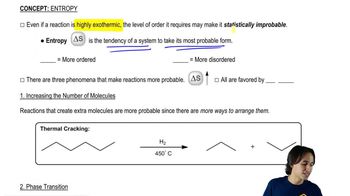
Entropy (ΔS) is a measure of the disorder or randomness in a system. A negative ΔS value, like -51 cal/mol•K, suggests that the process leads to a decrease in disorder, which can hinder spontaneity. In the Gibbs Free Energy equation, a negative ΔS can counteract the favorable effects of a negative ΔH, especially at higher temperatures.
Recommended video:
Guided course
02:46
Explaining what entropy is.