Ch. 5 - Chemical Reaction Analysis: Thermodynamics and Kinetics
Mullins - Organic Chemistry: A Learner Centered Approach 1st Edition
Mullins1st EditionOrganic Chemistry: A Learner Centered ApproachISBN: 9780137566471Not the one you use?Change textbook
Chapter 4, Problem 3b

Which is the most stable base in each pair?
(b) HS and HO

Verified step by step guidance
1
Compare the conjugate acids of the given bases (HS⁻ and HO⁻). The stability of a base is inversely related to the strength of its conjugate acid. The weaker the conjugate acid, the more stable the base.
The conjugate acid of HS⁻ is H₂S, and the conjugate acid of HO⁻ is H₂O. Analyze the acid strengths of H₂S and H₂O by considering their positions in the periodic table and their bond strengths.
Sulfur (S) is larger and less electronegative than oxygen (O). This means the H–S bond in H₂S is weaker and more easily broken compared to the H–O bond in H₂O, making H₂S a stronger acid than H₂O.
Since H₂S is a stronger acid than H₂O, its conjugate base (HS⁻) is less stable compared to the conjugate base of H₂O (HO⁻).
Conclude that HO⁻ is the more stable base in this pair because it is derived from the weaker acid (H₂O).

Verified video answer for a similar problem:

This video solution was recommended by our tutors as helpful for the problem above.
Video duration:
2m
Was this helpful?

Key Concepts

Here are the essential concepts you must grasp in order to answer the question correctly.

Acidity and Basicity

Acidity and basicity are fundamental concepts in organic chemistry that describe the tendency of a substance to donate or accept protons (H+ ions). A stronger acid has a weaker conjugate base, while a stronger base has a weaker conjugate acid. Understanding the relative strengths of acids and bases is crucial for predicting the stability of ions like HS– and HO–.
Recommended video:
Guided course
06:21
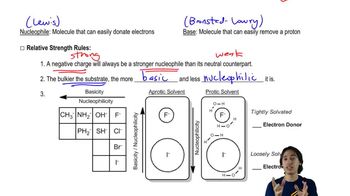
Understanding the difference between basicity and nucleophilicity.

Conjugate Acid-Base Pairs

Conjugate acid-base pairs consist of two species that differ by the presence or absence of a proton. For example, HS– is the conjugate base of H2S, while HO– is the conjugate base of H2O. The stability of these pairs can be assessed by examining the strength of their corresponding acids, which influences the stability of the bases.
Recommended video:
2:56
Base Pairing Concept 1

Electronegativity and Charge Stability

Electronegativity refers to the ability of an atom to attract electrons in a bond. In the context of anions like HS– and HO–, the stability of the negative charge is influenced by the electronegativity of the atom bearing the charge. A more electronegative atom can better stabilize a negative charge, affecting the overall stability of the base.
Recommended video:
Guided course
1:47
Electronegativity