Ch. 6 - Stereoisomerism: Arrangement of Atoms in Space
Mullins - Organic Chemistry: A Learner Centered Approach 1st Edition
Mullins1st EditionOrganic Chemistry: A Learner Centered ApproachISBN: 9780137566471Not the one you use?Change textbook
Chapter 5, Problem 51e

Assign the absolute stereochemistry for each of the following molecules.
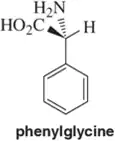
(e) Chemical structure of phenylglycine showing its amino and carboxyl groups with stereochemistry indicated.

Verified step by step guidance
1
Step 1: Identify the stereocenter in the molecule. The stereocenter is the carbon atom bonded to four different groups: the amino group (NH₂), the carboxylic acid group (CO₂H), the hydrogen atom (H), and the phenyl group (C₆H₅).
Step 2: Assign priorities to the substituents attached to the stereocenter based on the Cahn-Ingold-Prelog (CIP) priority rules. The priority is determined by atomic number: (1) CO₂H (highest priority due to oxygen), (2) NH₂, (3) C₆H₅, and (4) H (lowest priority).
Step 3: Orient the molecule so that the lowest priority group (H) is pointing away from you. This is typically represented as a dashed wedge in the diagram.
Step 4: Determine the order of the remaining three groups (CO₂H, NH₂, and C₆H₅) as you move clockwise or counterclockwise. Trace the path from the highest priority group (CO₂H) to the second (NH₂) and then to the third (C₆H₅).
Step 5: Assign the absolute configuration based on the direction of the path. If the path is clockwise, the configuration is R. If the path is counterclockwise, the configuration is S.

Verified video answer for a similar problem:

This video solution was recommended by our tutors as helpful for the problem above.
Video duration:
5m
Was this helpful?

Key Concepts

Here are the essential concepts you must grasp in order to answer the question correctly.

Stereochemistry

Stereochemistry is the study of the spatial arrangement of atoms in molecules and how this affects their chemical behavior. It is crucial for understanding isomers, particularly enantiomers, which are non-superimposable mirror images of each other. In organic chemistry, stereochemistry is often denoted using the R/S system, which helps in assigning absolute configurations to chiral centers.
Recommended video:
1:38
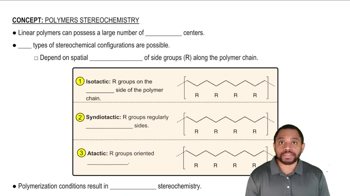
Polymer Stereochemistry Concept 1

Chirality

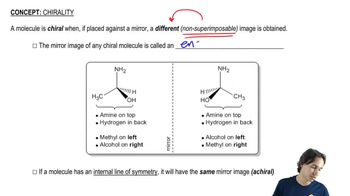
Chirality refers to the property of a molecule that makes it non-superimposable on its mirror image, much like left and right hands. A chiral molecule typically has one or more chiral centers, usually carbon atoms bonded to four different substituents. Identifying chirality is essential for assigning stereochemistry, as it determines the molecule's optical activity and interactions in biological systems.
Recommended video:
Guided course
05:10
What is chirality?

Cahn-Ingold-Prelog Priority Rules

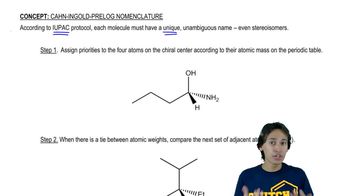
The Cahn-Ingold-Prelog (CIP) priority rules are a set of guidelines used to assign priorities to substituents attached to a chiral center based on atomic number and connectivity. The highest priority is given to the atom with the highest atomic number directly attached to the chiral center. These rules are fundamental for determining the R or S configuration of chiral molecules, which is necessary for accurately describing their stereochemistry.
Recommended video:
Guided course
01:48
Why stereoisomers need their own naming system.