
Ch. 6 - Stereoisomerism: Arrangement of Atoms in Space
Mullins - Organic Chemistry: A Learner Centered Approach 1st Edition
Mullins1st EditionOrganic Chemistry: A Learner Centered ApproachISBN: 9780137566471Not the one you use?Change textbook
Chapter 5, Problem 32

Imagine a sample that is enriched in the R enantiomer. If the % ee of the sample is 83%,
(a) what percent of the mixture is racemic?
(b) What is the ratio of R to S?

Verified step by step guidance
1
Step 1: Understand the concept of enantiomeric excess (% ee). Enantiomeric excess is defined as the difference in percentage between the two enantiomers in a mixture. Mathematically, % ee = |%R - %S|, where %R and %S are the percentages of the R and S enantiomers, respectively.
Step 2: Recognize that a racemic mixture contains equal amounts of R and S enantiomers (50% R and 50% S). If the sample is enriched in the R enantiomer, the % ee represents the excess of the R enantiomer over the racemic portion of the mixture.
Step 3: To determine the percentage of the mixture that is racemic, use the relationship: % racemic = 100% - % ee. Substitute the given % ee value (83%) into this equation to calculate the racemic portion.
Step 4: To find the ratio of R to S, first calculate the percentages of R and S in the mixture. Use the formula: %R = (% ee + % racemic / 2) and %S = (% racemic / 2). These equations account for the enantiomeric excess and the racemic portion.
Step 5: Once you have %R and %S, calculate the ratio of R to S by dividing %R by %S. This will give you the ratio of the R enantiomer to the S enantiomer in the mixture.

Verified video answer for a similar problem:

This video solution was recommended by our tutors as helpful for the problem above.
Video duration:
4m
Was this helpful?

Key Concepts

Here are the essential concepts you must grasp in order to answer the question correctly.

Enantiomers and Enantiomeric Excess (ee)

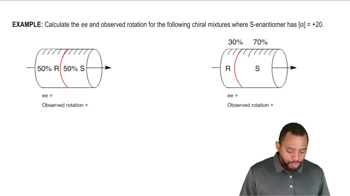
Enantiomers are pairs of molecules that are non-superimposable mirror images of each other, often referred to as R and S configurations. Enantiomeric excess (ee) quantifies the purity of one enantiomer over the other in a mixture, expressed as a percentage. An ee of 83% indicates that the sample is predominantly composed of one enantiomer, which is crucial for determining the composition of the mixture.
Recommended video:
Guided course
03:59
Calculating Enantiomeric Excess and Observed Rotation

Racemic Mixture

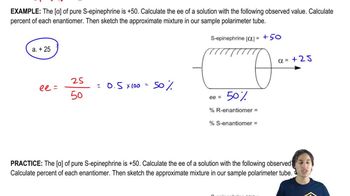
A racemic mixture contains equal amounts of both enantiomers, resulting in a 50% ee. To find the percentage of a racemic component in a mixture with a known enantiomeric excess, one can use the formula: % racemic = 100% - % ee. This concept is essential for calculating the proportion of the racemic mixture in the given sample.
Recommended video:
Guided course
03:08
Calculating EE, percent of each enantiomer, and sketching mixture

Ratio of Enantiomers

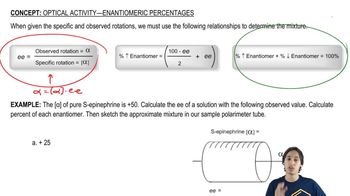
The ratio of R to S enantiomers in a mixture can be derived from the enantiomeric excess. If the ee is known, the ratio can be calculated using the formula: R:S = (ee + 100)/2 : (100 - ee)/2. This ratio provides insight into the relative amounts of each enantiomer present, which is critical for understanding the stereochemistry of the sample.
Recommended video:
Guided course
03:23
How to solve for the percentage of each enantiomer.
Related Practice
Textbook Question

Using a 1.0-cm polarimeter cell and a solution prepared by dissolving 2.54 g of glucose in 1 L of H₂O, the specific rotation of d-glucose was calculated to be +52.7° at 20 °C using the sodium D line as the source of light. What was the observed rotation of the solution?

1107
views
Textbook Question

A student wanted to measure the specific rotation of the following propionate derivative (density = 1.12 g/ml).

A sample of the pure compound was placed in a 10.0-cm polarimeter tube, and using the sodium D line, the observed rotation at 20°C was determined to be +46.6° . What is the specific rotation of the propionate derivative?

900
views
Textbook Question

(S)-Propranolol, a drug used for the treatment of anxiety, has a specific rotation of -25.5° . Attempting to prepare it in enantiopure form, a chemist produced a compound that gave a specific rotation of -18.3° . What is the ratio of (S)- to (R)-propranolol produced by the chemist?

1026
views
Textbook Question

(R)-Selegiline, a monoamine oxidase (MAO) inactivator, was approved by the FDA in 1989 for the treatment of Parkinson's disease. In pure form, it has a specific rotation, [α]²⁰D = - 11.0°. What is the expected specific rotation of a mixture containing 64% S and 36% R?

881
views
Textbook Question

Cholesterol (50 mg) was dissolved in 10 mL of chloroform and placed in a 1.0-cm polarimeter cell. This solution produced an observed rotation (using the sodium D line at 20°C ) of - 1.58° . What is the specific rotation of cholesterol?

972
views
Textbook Question

For the molecules shown,

(i) count the number of stereocenters present and

(ii) draw all possible stereoisomers.

(iii) Identify the relationships between stereoisomers as enantiomers or diastereomers.

(a)

1508
views