
Ch. 6 - Stereoisomerism: Arrangement of Atoms in Space
Mullins - Organic Chemistry: A Learner Centered Approach 1st Edition
Mullins1st EditionOrganic Chemistry: A Learner Centered ApproachISBN: 9780137566471Not the one you use?Change textbook
Chapter 5, Problem 57

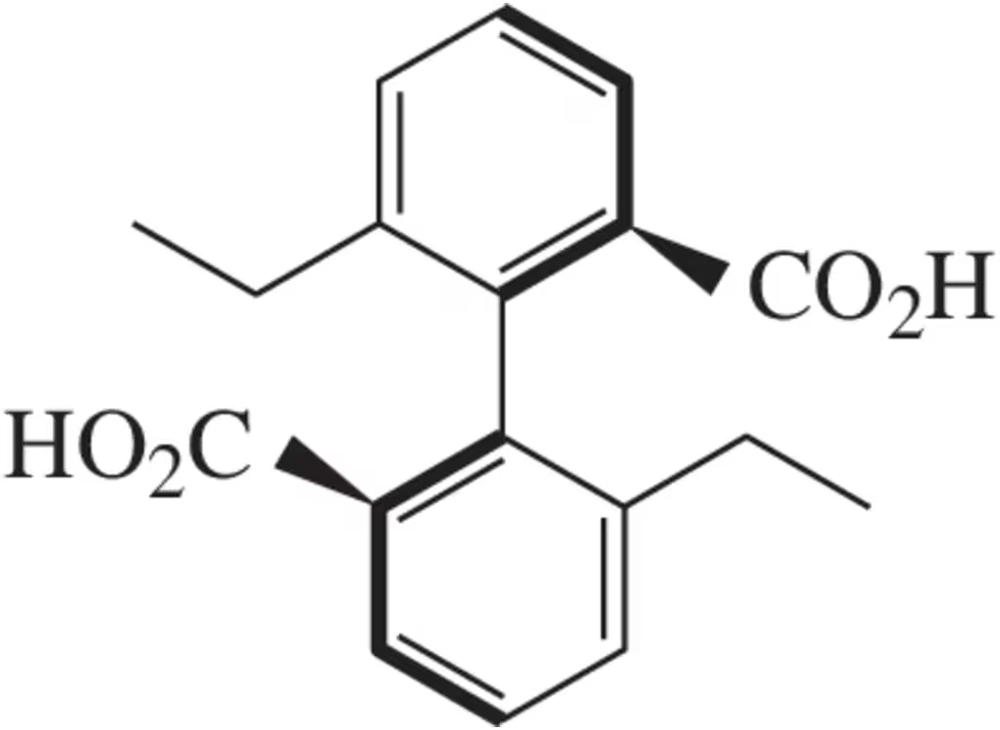
When the following substituted biphenyl was synthesized, it was found to have a specific rotation [α] of -23° at 25°C . When the specific rotation was measured at 100°C the compound had a specific rotation of 0° . Upon cooling back to 25°C the specific rotation was measured again, resulting in [α] = 0°. Explain these results.
Chemical structure of a substituted biphenyl with carboxylic acid groups, illustrating optical activity and specific rotation.

Verified step by step guidance
1
Step 1: Understand the concept of specific rotation ([α]). Specific rotation is a measure of the optical activity of a chiral compound, which depends on the molecular structure and the environment, such as temperature. A change in specific rotation indicates a change in the molecular configuration or equilibrium between different forms of the compound.
Step 2: Analyze the initial observation at 25°C ([α] = -23°). This suggests that the compound exists in a chiral form and exhibits optical activity. The negative value indicates the direction of rotation (counterclockwise).
Step 3: Consider the measurement at 100°C ([α] = 0°). A specific rotation of 0° implies that the compound is no longer optically active. This could occur if the compound undergoes racemization (conversion to a 50:50 mixture of enantiomers) or if it adopts an achiral configuration at higher temperatures.
Step 4: Examine the cooling back to 25°C ([α] = 0°). The fact that the specific rotation remains 0° suggests that the process at 100°C is irreversible. The compound likely underwent a structural change or racemization that prevents it from returning to its original chiral form upon cooling.
Step 5: Conclude that the results indicate a temperature-dependent equilibrium or irreversible structural change. At 25°C initially, the compound is chiral and optically active. At 100°C, the compound either racemizes or adopts an achiral configuration, and this change is irreversible, as evidenced by the lack of optical activity upon cooling back to 25°C.

Verified video answer for a similar problem:

This video solution was recommended by our tutors as helpful for the problem above.
Was this helpful?

Key Concepts

Here are the essential concepts you must grasp in order to answer the question correctly.

Specific Rotation

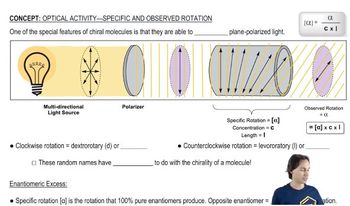
Specific rotation is a property of chiral compounds that quantifies the degree to which they rotate plane-polarized light. It is defined as the observed rotation of light at a specific wavelength and temperature, normalized by the concentration of the solution and the path length. The values can vary with temperature, indicating changes in the molecular arrangement or conformation of the compound.
Recommended video:
Guided course
05:43
Specific rotation vs. observed rotation.

Chirality and Conformational Changes

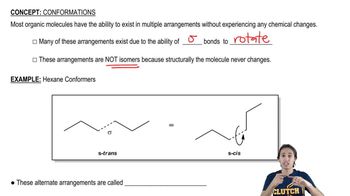
Chirality refers to the geometric property of a molecule that makes it non-superimposable on its mirror image, often leading to optical activity. In the case of biphenyl compounds, substituents can influence the spatial arrangement of the molecule, resulting in different conformations. These conformational changes can affect the specific rotation, as seen when the compound's rotation changes with temperature.
Recommended video:
Guided course
03:29
Understanding what a conformer is.

Thermal Effects on Optical Activity

Temperature can significantly influence the optical activity of chiral compounds due to changes in molecular motion and conformation. As temperature increases, the kinetic energy of the molecules rises, potentially leading to a more random arrangement that can diminish or eliminate optical activity. The observed results, where specific rotation changes with temperature, suggest that the compound may have undergone a conformational change that affected its chirality.
Recommended video:
Guided course
08:17
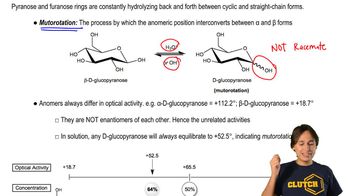
Mutorotation and Optical Activity
Related Practice
Textbook Question

A chemist working on the synthesis of (+)-pilocarpine, an alkaloid used in the treatment of dry mouth and glaucoma, produced a mixture of enantiomers that gave a specific rotation [α]D = +97°. Based on the specific rotation of the pure enantiomer, calculate the ratio of (+)- to (-)-pilocarpine produced by the chemist.

1003
views
Textbook Question

As we learned in Chapter 2, we don't need to show hydrogens bonded to carbons when drawing organic molecules using line-angle formulas. At asymmetric centers, however, we often show the hydrogen. Why? When might it be unnecessary to show the hydrogen at a chiral center?

1057
views
Textbook Question

A compound with two chiral centers that is meso will always have opposite absolute configurations at the two chiral centers. That is, a meso compound will never be (R,R) or (S,S); instead, it will be (R,S). Explain why this must be true.

1575
views
Textbook Question

Draw the enantiomer of each of the molecules you drew in Assessment 6.52.

1119
views
Textbook Question

Natural products are organic compounds produced by living organisms, including plants, fungi, and animals. Often referred to as secondary metabolites because they are not required for survival of the organism, natural products have found broad utility as drugs themselves or as lead compounds used in the development of medicines. One such example is paclitaxel, which has been used as a cancer drug. Paclitaxel is isolated from the yew tree, where it is produced as a single stereoisomer (shown). Based on its structure, how many stereoisomers are possible for paclitaxel?

1105
views
Textbook Question

In Chapter 12, we introduce the SN2 reaction, a nucleophilic substitution reaction that proceeds with inversion. Confirm that inversion has occurred in each of the following examples by determining the absolute configuration of the chiral center in the reactants and products.

(a)

1212
views