
Ch. 6 - Stereoisomerism: Arrangement of Atoms in Space
Mullins - Organic Chemistry: A Learner Centered Approach 1st Edition
Mullins1st EditionOrganic Chemistry: A Learner Centered ApproachISBN: 9780137566471Not the one you use?Change textbook
Chapter 5, Problem 39

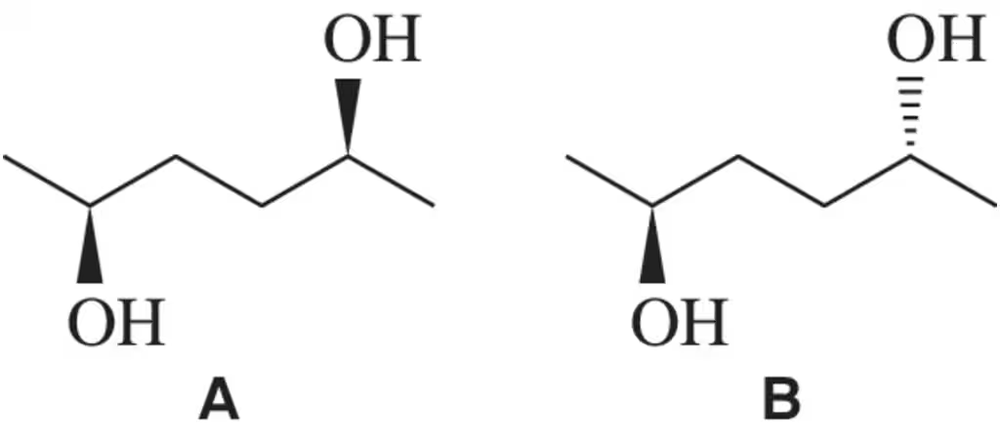
Which of the following diastereomers of hexane-2,5-diol is optically inactive? Why?
Structures of two diastereomers of hexane-2,5-diol labeled A and B, showing their hydroxyl (OH) groups.

Verified step by step guidance
1
Step 1: Understand the structure of hexane-2,5-diol. It is a six-carbon chain with hydroxyl (-OH) groups attached to the second and fifth carbons. These carbons are chiral centers because they are bonded to four different groups.
Step 2: Recall the concept of diastereomers. Diastereomers are stereoisomers that are not mirror images of each other. They differ in the spatial arrangement of groups around at least one chiral center.
Step 3: Consider the possibility of symmetry in the molecule. A molecule is optically inactive if it has a plane of symmetry or a center of symmetry, as these features cancel out optical activity.
Step 4: Analyze the diastereomers of hexane-2,5-diol. If the configuration of the chiral centers (C2 and C5) is such that the molecule has a plane of symmetry (e.g., one chiral center is R and the other is S), the molecule will be a meso compound and optically inactive.
Step 5: Conclude that the diastereomer of hexane-2,5-diol with opposite configurations at C2 and C5 (e.g., R,S or S,R) is optically inactive due to the presence of a plane of symmetry, making it a meso compound.

Verified video answer for a similar problem:

This video solution was recommended by our tutors as helpful for the problem above.
Was this helpful?

Key Concepts

Here are the essential concepts you must grasp in order to answer the question correctly.

Diastereomers

Diastereomers are stereoisomers that are not mirror images of each other. They occur when a molecule has multiple chiral centers, leading to different spatial arrangements of atoms. Unlike enantiomers, which have identical physical properties except for their optical activity, diastereomers can have different boiling points, melting points, and reactivities, making their study crucial in organic chemistry.
Recommended video:
Guided course
03:44
Using chiral centers to predict types of stereoisomers.

Optical Activity

Optical activity refers to the ability of a chiral compound to rotate plane-polarized light. A compound is optically active if it has at least one chiral center and lacks an internal plane of symmetry. In contrast, compounds that are achiral or have a plane of symmetry do not rotate light and are considered optically inactive, which is essential for determining the properties of diastereomers.
Recommended video:
Guided course
08:17
Mutorotation and Optical Activity

Chirality and Symmetry

Chirality is a property of a molecule that makes it non-superimposable on its mirror image, typically due to the presence of chiral centers. A molecule is considered optically inactive if it possesses an internal plane of symmetry, which allows it to exist in two mirror-image forms that cancel out their optical activities. Understanding chirality and symmetry is vital for identifying which diastereomers of hexane-2,5-diol are optically inactive.
Recommended video:
Guided course
00:25
Determining Chirality with Plane of Symmetry