Ch. 8 - Alkenes I: Properties and Electrophilic Additions
Mullins - Organic Chemistry: A Learner Centered Approach 1st Edition
Mullins1st EditionOrganic Chemistry: A Learner Centered ApproachISBN: 9780137566471Not the one you use?Change textbook
Chapter 7, Problem 40

For each of the products you predicted in Assessment 8.39, provide an arrow-pushing mechanism which rationalizes the formation of each product. Make sure your mechanism accounts for all products formed, including stereoisomers and regioisomers, where applicable.

Verified step by step guidance
1
Identify the reactants and reaction conditions provided in Assessment 8.39. Determine the type of reaction (e.g., substitution, elimination, addition, etc.) and the functional groups involved.
Predict the products of the reaction based on the reaction type and the regioselectivity or stereoselectivity rules (e.g., Markovnikov's rule, anti-Markovnikov addition, syn/anti addition, etc.). Ensure you account for all possible stereoisomers and regioisomers.
Draw the starting structure and use curved arrows to represent the movement of electrons during each step of the reaction mechanism. Begin with the initiation step (if applicable) or the interaction of the reactants.
For each intermediate formed, analyze its stability (e.g., carbocation stability, resonance effects, steric hindrance) and show how it leads to the next step in the mechanism. Use curved arrows to depict electron flow leading to the formation of the products.
For each product, clearly indicate the stereochemistry (if applicable) and explain how the mechanism accounts for the formation of all observed products, including regioisomers and stereoisomers. Ensure the mechanism is consistent with the reaction conditions provided.

Verified video answer for a similar problem:

This video solution was recommended by our tutors as helpful for the problem above.
Video duration:
8m
Was this helpful?

Key Concepts

Here are the essential concepts you must grasp in order to answer the question correctly.

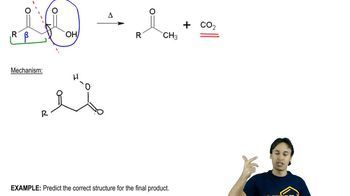
Arrow-Pushing Mechanism

Arrow-pushing mechanisms are diagrams that illustrate the movement of electrons during chemical reactions. They use arrows to show the direction of electron flow, indicating how bonds are formed or broken. Understanding these mechanisms is crucial for predicting reaction products and understanding the underlying chemistry of organic reactions.
Recommended video:
Guided course
04:32
General Mechanism

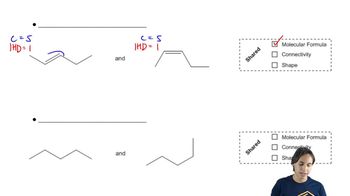
Stereoisomers

Stereoisomers are compounds that have the same molecular formula and connectivity of atoms but differ in the spatial arrangement of their atoms. This concept is essential in organic chemistry as it affects the physical and chemical properties of the compounds. Recognizing stereoisomers is important when predicting the products of reactions, especially in chiral environments.
Recommended video:
Guided course
01:58
Determining when molecules are stereoisomers.

Regioisomers

Regioisomers are isomers that differ in the position of a functional group or substituent within a molecule. This concept is significant in organic reactions where multiple products can form due to different possible sites of reaction. Understanding regioisomer formation helps in rationalizing the products of a reaction and predicting the major and minor products based on stability and reactivity.