Ch. 8 - Alkenes I: Properties and Electrophilic Additions
Mullins - Organic Chemistry: A Learner Centered Approach 1st Edition
Mullins1st EditionOrganic Chemistry: A Learner Centered ApproachISBN: 9780137566471Not the one you use?Change textbook
Chapter 7, Problem 6a

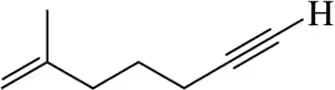
Given the structure, calculate the index of hydrogen deficiency (degrees of unsaturation) of the following molecules.
(a) Chemical structure of a hydrocarbon with a triple bond and a branch, used for calculating degrees of unsaturation.

Verified step by step guidance
1
Step 1: Understand the formula for calculating the Index of Hydrogen Deficiency (IHD). The formula is: IHD = (2C + 2 + N - H - X) / 2, where C = number of carbons, H = number of hydrogens, N = number of nitrogens, and X = number of halogens (e.g., F, Cl, Br, I). Oxygen atoms do not affect the calculation.
Step 2: Identify the molecular formula of the given structure. Count the number of carbons (C), hydrogens (H), nitrogens (N), and halogens (X) in the molecule.
Step 3: Substitute the values of C, H, N, and X into the IHD formula. Ensure that you perform the arithmetic operations carefully.
Step 4: Interpret the result of the IHD calculation. Each unit of IHD corresponds to one degree of unsaturation, which could represent a double bond, a ring, or a triple bond (which counts as two degrees).
Step 5: Verify your result by analyzing the structure of the molecule. Check for the presence of double bonds, triple bonds, or rings to confirm the calculated IHD matches the structural features.

Verified video answer for a similar problem:

This video solution was recommended by our tutors as helpful for the problem above.
Was this helpful?

Key Concepts

Here are the essential concepts you must grasp in order to answer the question correctly.

Index of Hydrogen Deficiency (IHD)

The Index of Hydrogen Deficiency (IHD), also known as degrees of unsaturation, indicates the number of rings and/or multiple bonds in a molecule. It is calculated using the formula IHD = (2C + 2 + N - H - X) / 2, where C is the number of carbons, N is the number of nitrogens, H is the number of hydrogens, and X is the number of halogens. A higher IHD suggests more unsaturation, which can affect the molecule's reactivity and stability.
Recommended video:
Guided course
01:15
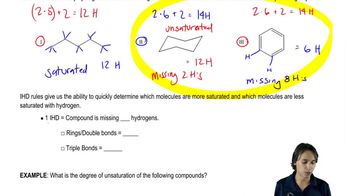
What index of hydrogen deficiency is.

Molecular Structure

Understanding the molecular structure is crucial for calculating IHD, as it involves identifying the number of carbon, hydrogen, nitrogen, and halogen atoms present. The arrangement of these atoms, including any functional groups or rings, directly influences the degree of unsaturation. A clear representation of the molecular structure, such as a Lewis structure or skeletal formula, helps in visualizing and counting the relevant atoms.
Recommended video:
Guided course
08:41
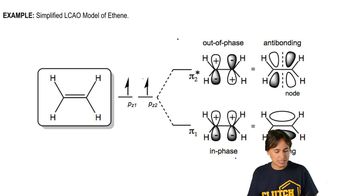
Review of Molecular Orbitals

Functional Groups

Functional groups are specific groups of atoms within molecules that are responsible for the characteristic chemical reactions of those molecules. Recognizing functional groups is essential when calculating IHD, as they can contribute to the overall unsaturation of the molecule. For example, double bonds and rings increase the IHD, while single bonds do not, making it important to identify these features in the molecular structure.
Recommended video:
Guided course
02:36
Identifying Functional Groups