
Ch. 8 - Alkenes I: Properties and Electrophilic Additions
Mullins - Organic Chemistry: A Learner Centered Approach 1st Edition
Mullins1st EditionOrganic Chemistry: A Learner Centered ApproachISBN: 9780137566471Not the one you use?Change textbook
Chapter 7, Problem 74b

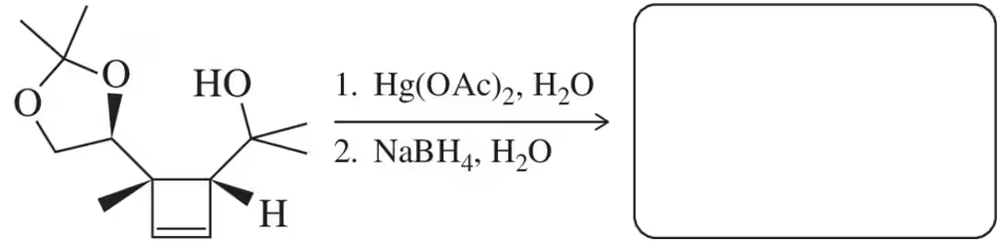
In light of your answer to Assessment 8.73, predict the product of the following oxymercuration–reduction reactions, each of which results in a single product. [Don't worry about the absolute stereochemistry, though these reactions are also stereoselective.]
(b) This reaction sequence was used in the synthesis of (+) -lineatin, a monoterpene aggregation pheromone from the female ambrosia beetle Trypodendron lineatum (Org. Lett. 2004, 6, 1449–1452).
Oxymercuration-reduction reaction scheme with reagents and an empty product box.

Verified step by step guidance
1
Identify the reaction type: The given reaction is an oxymercuration-reduction reaction, which is used to convert alkenes to alcohols without rearrangement.
Analyze the starting material: The structure contains a cyclobutene ring with a hydroxyl group and an ester group. The double bond is the site of reaction.
Understand the mechanism: In the first step, oxymercuration involves the addition of mercuric acetate (Hg(OAc)₂) and water across the double bond, forming a mercurinium ion intermediate.
Predict the regioselectivity: The mercurinium ion is attacked by water at the more substituted carbon, leading to Markovnikov addition of the hydroxyl group.
Complete the reaction: In the second step, sodium borohydride (NaBH₄) reduces the mercurinium ion, replacing the mercury with a hydrogen atom, resulting in the formation of the alcohol product.

Verified video answer for a similar problem:

This video solution was recommended by our tutors as helpful for the problem above.
Video duration:
4m
Was this helpful?

Key Concepts

Here are the essential concepts you must grasp in order to answer the question correctly.

Oxymercuration-Demercuration

Oxymercuration-demercuration is a two-step reaction used to convert alkenes into alcohols. The first step involves the addition of mercuric acetate (Hg(OAc)2) and water, forming a mercurinium ion intermediate. The second step uses sodium borohydride (NaBH4) to reduce the intermediate, replacing the mercury with a hydrogen atom, resulting in an alcohol with Markovnikov orientation.
Recommended video:
Guided course
05:
General properties of oxymercuration-reduction.

Markovnikov's Rule

Markovnikov's rule predicts the regiochemistry of electrophilic addition reactions, stating that the hydrogen atom will add to the less substituted carbon of the double bond, while the more substituted carbon receives the other group. In oxymercuration-demercuration, this rule ensures the alcohol forms at the more substituted carbon, providing regioselectivity in the product formation.
Recommended video:
Guided course
03:54
The 18 and 16 Electron Rule

Stereoselectivity

Stereoselectivity refers to the preference for the formation of one stereoisomer over another in a chemical reaction. Although oxymercuration-demercuration is stereoselective, the question specifies not to worry about absolute stereochemistry. This implies that the reaction will favor a specific stereochemical outcome, but the focus is on the regiochemistry of the product.
Related Practice
Textbook Question

In light of your answer to Assessment 8.73, predict the product of the following oxymercuration–reduction reactions, each of which results in a single product. [Don't worry about the absolute stereochemistry, though these reactions are also stereoselective.]

(c) Oxymercuration–reduction was used in the stereoselective synthesis of the macrolactone core of neopeltolide, a marine macrolide isolated from a Caribbean sponge that has potent anticancer activity (Org. Lett. 2012, 14, 2346–2349).

626
views
Textbook Question

Predict the product of each of the following hydroboration–oxidation or oxymercuration–reduction reactions used in the modern synthetic organic chemistry literature (modified to use reagents we are used to seeing).

(b) A two-step hydroboration–oxidation was used to prepare a silanediol peptidomimetic as a serine protease inhibitor (Org. Lett. 2012, 14, 4422–4425).

1022
views
Textbook Question

A common situation occurs when both carbons of the mercurinium ion are secondary. In a situation like the one shown, to which carbon would you expect water to add? That is, would you expect to produce A or B? Explain your answer.

1119
views
Textbook Question

North American termite soldiers, when encountering enemy insects, contract their mandibular muscles, expelling a mixture of chemicals that essentially trap their enemies in a glue-like substance. This weapon, built into the face of the termite, is called the fontanellar gun. It releases a mixture of pinene (62%), myrcene (27%), and limonene (11%). pinene myrcene limonene 62% 27% 11%

(a) Identify the isoprene units in pinene, myrcene, and limonene.

1068
views
Textbook Question

Predict the product of each of the following hydroboration–oxidation or oxymercuration–reduction reactions used in the modern synthetic organic chemistry literature (modified to use reagents we are used to seeing).

(c) A similar sequence was featured in the synthesis of muricadienin, a proposed precursor in the biosynthesis of solamin (Org. Lett. 2014, 16, 5886–5889).

834
views
Textbook Question

The formation of five-membered ring ethers is an important goal in synthetic organic chemistry because tetrahydrofurans are contained within a number of antitumor natural products. Toward that end, a one-pot synthesis of a bis-THF containing compound was developed (Eur. J. Org. Chem. 2010, 6263–6268). Suggest a mechanism for this transformation.

1067
views