Ch. 8 - Alkenes I: Properties and Electrophilic Additions
Mullins - Organic Chemistry: A Learner Centered Approach 1st Edition
Mullins1st EditionOrganic Chemistry: A Learner Centered ApproachISBN: 9780137566471Not the one you use?Change textbook
Chapter 7, Problem 11a

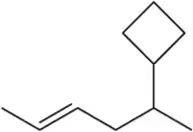
Name the following alkenes, being sure to specify whether they are cis or trans.
(a) Chemical structure of an alkene with a double bond, labeled for cis or trans isomer identification.

Verified step by step guidance
1
Step 1: Identify the longest continuous carbon chain that contains the double bond. This will serve as the parent chain, and its name will be based on the number of carbons in the chain (e.g., 'pentene' for a 5-carbon chain with a double bond).
Step 2: Number the parent chain starting from the end closest to the double bond. This ensures the double bond gets the lowest possible number. Indicate the position of the double bond in the name (e.g., '2-pentene' if the double bond starts at carbon 2).
Step 3: Determine whether the double bond is cis or trans. For cis, the substituents on the double-bonded carbons are on the same side; for trans, they are on opposite sides. Use this information to add the appropriate prefix ('cis-' or 'trans-') to the name.
Step 4: Identify and name any substituents attached to the parent chain. Assign numbers to these substituents based on their position on the parent chain, and include them in the name in alphabetical order.
Step 5: Combine all elements of the name: the cis/trans designation, substituents, position of the double bond, and the parent chain name. Ensure the name follows IUPAC nomenclature rules.

Verified video answer for a similar problem:

This video solution was recommended by our tutors as helpful for the problem above.
Video duration:
4m
Was this helpful?

Key Concepts

Here are the essential concepts you must grasp in order to answer the question correctly.

Alkene Nomenclature

Alkenes are hydrocarbons that contain at least one carbon-carbon double bond. Their naming follows the IUPAC system, which involves identifying the longest carbon chain containing the double bond, numbering the chain to give the double bond the lowest possible number, and using suffixes like '-ene' to indicate the presence of the double bond.
Recommended video:
4:02
Nomenclature of Heterocycles Concept 2

Cis-Trans Isomerism

Cis-trans isomerism, also known as geometric isomerism, occurs in alkenes due to the restricted rotation around the double bond. In cis isomers, substituents are on the same side of the double bond, while in trans isomers, they are on opposite sides. This distinction affects the physical properties and reactivity of the compounds.
Recommended video:
Guided course
00:44
Is the following cyclohexane cis or trans?

Priority Rules for Substituents

To determine whether an alkene is cis or trans, it is essential to apply the Cahn-Ingold-Prelog priority rules. These rules assign priority to substituents based on atomic number; higher atomic numbers receive higher priority. The configuration is then classified as cis if the higher priority groups are on the same side and trans if they are on opposite sides of the double bond.
Recommended video:
Guided course
03:54
The 18 and 16 Electron Rule