Ch. 8 - Alkenes I: Properties and Electrophilic Additions
Mullins - Organic Chemistry: A Learner Centered Approach 1st Edition
Mullins1st EditionOrganic Chemistry: A Learner Centered ApproachISBN: 9780137566471Not the one you use?Change textbook
Chapter 7, Problem 48

Our wayward chemist from Assessment 8.23 suggested the following stepwise mechanism for a hydride shift. Show this mechanism on a reaction coordinate diagram to illustrate why the concerted mechanism is more likely. Justify the picture you have drawn.

Verified step by step guidance
1
Begin by understanding the concept of a hydride shift. A hydride shift involves the migration of a hydride ion (H⁻) from one carbon to an adjacent carbon, often to stabilize a carbocation.
Examine the provided mechanism. The first step shows a carbocation on a cyclohexane ring, with a hydride shift occurring from the adjacent carbon to stabilize the carbocation.
Consider the energy profile of the stepwise mechanism. Each step in the mechanism involves the formation of an intermediate, which typically has higher energy than the reactants or products. This can be illustrated on a reaction coordinate diagram with multiple peaks corresponding to the intermediates.
Contrast this with a concerted mechanism, where the hydride shift occurs in a single step without forming high-energy intermediates. The reaction coordinate diagram for a concerted mechanism would show a smoother transition with a single energy barrier.
Justify why the concerted mechanism is more likely. The concerted mechanism is favored because it avoids the formation of high-energy intermediates, resulting in a lower overall energy barrier and a more stable transition state.

Verified video answer for a similar problem:

This video solution was recommended by our tutors as helpful for the problem above.
Was this helpful?

Key Concepts

Here are the essential concepts you must grasp in order to answer the question correctly.

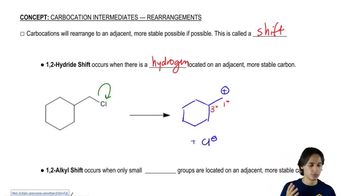
Hydride Shift

A hydride shift involves the migration of a hydride ion (H-) from one carbon to an adjacent carbon, often to stabilize a carbocation. This rearrangement can lead to a more stable carbocation, facilitating subsequent reactions. Understanding hydride shifts is crucial for predicting reaction pathways and product formation in organic chemistry.
Recommended video:
Guided course
03:34
Hydride Shift

Reaction Coordinate Diagram

A reaction coordinate diagram visually represents the energy changes during a chemical reaction. It plots the progress of the reaction against the energy level, showing the transition states and intermediates. This diagram helps in comparing the energy profiles of stepwise versus concerted mechanisms, illustrating which pathway is energetically favorable.
Recommended video:
Guided course
05:02
Coordination Complexes

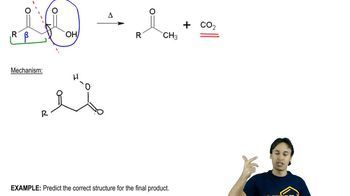
Concerted Mechanism

A concerted mechanism involves simultaneous bond-breaking and bond-forming steps, occurring in a single transition state without intermediates. This mechanism is often favored when it results in a lower energy pathway compared to stepwise processes. Understanding concerted mechanisms is essential for predicting reaction kinetics and stability in organic transformations.
Recommended video:
Guided course
04:32
General Mechanism