Ch. 8 - Alkenes I: Properties and Electrophilic Additions
Mullins - Organic Chemistry: A Learner Centered Approach 1st Edition
Mullins1st EditionOrganic Chemistry: A Learner Centered ApproachISBN: 9780137566471Not the one you use?Change textbook
Chapter 7, Problem 61g(iii)

Predict the product(s) that would result when the alkenes shown here are allowed to react under the following conditions: (iii) HBr, H2O2
(g) Structural representation of alkenes for hydrohalogenation reaction with HBr.

Verified step by step guidance
1
Step 1: Recognize the reaction conditions. The presence of HBr and H₂O₂ indicates that this is a free radical addition reaction, which follows anti-Markovnikov regioselectivity. This is due to the peroxide effect (also known as the Kharasch effect).
Step 2: Understand the mechanism. In the presence of H₂O₂, the reaction proceeds via a radical mechanism rather than the typical electrophilic addition. The bromine atom will add to the less substituted carbon of the double bond, contrary to Markovnikov's rule.
Step 3: Identify the alkene structure. Examine the given alkene and determine the positions of the double bond and substituents. This will help you predict where the bromine atom will attach.
Step 4: Predict the product. Based on anti-Markovnikov addition, the bromine atom will attach to the less substituted carbon of the double bond, while the hydrogen atom will attach to the more substituted carbon.
Step 5: Verify stereochemistry (if applicable). If the alkene is asymmetric or has stereochemical implications, consider whether the product will be a racemic mixture or have specific stereochemistry due to the radical mechanism.

Verified video answer for a similar problem:

This video solution was recommended by our tutors as helpful for the problem above.
Was this helpful?

Key Concepts

Here are the essential concepts you must grasp in order to answer the question correctly.

Electrophilic Addition

Electrophilic addition is a fundamental reaction mechanism in organic chemistry where an electrophile reacts with a nucleophile, typically involving alkenes. In the case of alkenes reacting with HBr, the double bond acts as a nucleophile, attacking the electrophilic hydrogen atom, leading to the formation of a carbocation intermediate. This process is crucial for predicting the products of reactions involving alkenes.
Recommended video:
Guided course
09:23
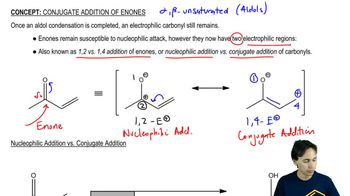
1,2 vs 1,4 Addition

Markovnikov's Rule

Markovnikov's Rule states that in the addition of HX (where X is a halogen) to an alkene, the hydrogen atom will attach to the carbon with the greater number of hydrogen atoms already attached. This rule helps predict the regioselectivity of the reaction, guiding the formation of the more stable carbocation and ultimately influencing the major product formed during the reaction with HBr.
Recommended video:
Guided course
03:54
The 18 and 16 Electron Rule

Anti-Markovnikov Addition

Anti-Markovnikov addition occurs when the addition of HX to an alkene results in the halogen attaching to the less substituted carbon atom. This is often facilitated by the presence of peroxides (like H₂O₂) in the reaction, which can lead to a radical mechanism. Understanding this concept is essential for predicting the products when alkenes react with HBr in the presence of H₂O₂, as it alters the expected regioselectivity.
Recommended video:
Guided course
02:43
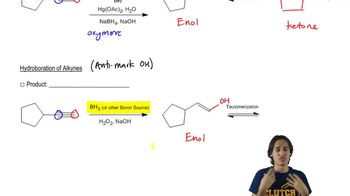
Anti-Markovnikov addition of alcohols to terminal alkynes yields aldehydes