Ch. 8 - Alkenes I: Properties and Electrophilic Additions
Mullins - Organic Chemistry: A Learner Centered Approach 1st Edition
Mullins1st EditionOrganic Chemistry: A Learner Centered ApproachISBN: 9780137566471Not the one you use?Change textbook
Chapter 7, Problem 55c

Suggest an alkene to undergo hydroboration–oxidation (1. BH3 2. NaOH, H2O2) to give exclusively the alcohols shown. Pay close attention to the relative (but not absolute) stereochemical outcome.
(c)

Verified step by step guidance
1
Analyze the product structure: The alcohol group (-OH) is attached to a carbon that is stereochemically defined (wedge bond indicates stereochemistry). This suggests that the reaction involves stereospecificity.
Recall the mechanism of hydroboration–oxidation: This reaction adds water across the double bond of an alkene in an anti-Markovnikov fashion, meaning the -OH group will attach to the less substituted carbon. Additionally, the reaction proceeds with syn addition, meaning both the hydrogen and hydroxyl group are added to the same face of the alkene.
Determine the alkene structure: To achieve the observed stereochemistry, the starting alkene must have a double bond positioned such that the less substituted carbon becomes the site of hydroxyl group attachment. The stereochemistry of the product suggests that the alkene must have a cis configuration to allow syn addition.
Propose the alkene: Based on the product structure, the alkene should have a phenyl group (Ph) and an ethyl group on one side of the double bond, and a methyl group on the other side. The double bond should be positioned between the carbon bearing the phenyl group and the carbon bearing the methyl group.
Verify stereochemical outcome: Ensure that the proposed alkene, when undergoing hydroboration–oxidation, will lead to the observed stereochemistry of the alcohol product. The syn addition mechanism ensures that the hydrogen and hydroxyl group are added to the same face, resulting in the correct relative stereochemistry.

Verified video answer for a similar problem:

This video solution was recommended by our tutors as helpful for the problem above.
Video duration:
1m
Was this helpful?

Key Concepts

Here are the essential concepts you must grasp in order to answer the question correctly.

Hydroboration-Oxidation

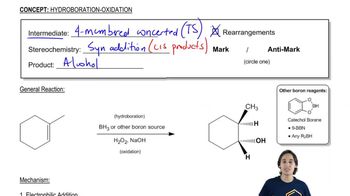
Hydroboration-oxidation is a two-step reaction that converts alkenes into alcohols. In the first step, borane (BH₃) adds across the double bond of the alkene, resulting in a trialkylborane intermediate. The second step involves oxidation with hydrogen peroxide (H₂O₂) and a base (NaOH), which replaces the boron with a hydroxyl group, yielding an alcohol. This reaction is notable for its syn-addition mechanism, leading to specific stereochemical outcomes.
Recommended video:
Guided course
06:38
General properties of hydroboration-oxidation.

Stereochemistry

Stereochemistry refers to the study of the spatial arrangement of atoms in molecules and how this affects their chemical behavior. In the context of hydroboration-oxidation, the stereochemical outcome is influenced by the syn-addition mechanism, which results in the formation of alcohols with specific stereochemical configurations. Understanding stereochemistry is crucial for predicting the relative configurations of products formed from reactions involving chiral centers.
Recommended video:
1:38
Polymer Stereochemistry Concept 1

Alkene Reactivity

Alkenes are reactive compounds due to the presence of a carbon-carbon double bond, which can undergo various addition reactions. The reactivity of alkenes in hydroboration-oxidation is influenced by factors such as sterics and electronic effects. When selecting an alkene for this reaction, it is essential to consider how substituents on the double bond will affect the regioselectivity and stereoselectivity of the resulting alcohol, particularly in the context of the desired product structure.
Recommended video:
2:09
Alkene Metathesis Concept 1