Ch. 8 - Alkenes I: Properties and Electrophilic Additions
Mullins - Organic Chemistry: A Learner Centered Approach 1st Edition
Mullins1st EditionOrganic Chemistry: A Learner Centered ApproachISBN: 9780137566471Not the one you use?Change textbook
Chapter 7, Problem 8.55b

Suggest an alkene to undergo hydroboration–oxidation (1. BH3 2. NaOH, H2O2) to give exclusively the alcohols shown. Pay close attention to the relative (but not absolute) stereochemical outcome.
(b)

Verified step by step guidance
1
Analyze the product structure: The alcohol group (-OH) is attached to a carbon that is adjacent to a phenyl group (Ph) and has stereochemistry. This suggests that the reaction involves regioselectivity and stereoselectivity.
Recall the mechanism of hydroboration–oxidation: Hydroboration adds BH₃ to the alkene in a syn addition, followed by oxidation with NaOH and H₂O₂ to replace the boron with an -OH group. The reaction proceeds with anti-Markovnikov regioselectivity, meaning the -OH group will attach to the less substituted carbon of the double bond.
Determine the alkene structure: To form the given alcohol, the alkene must have a double bond between the carbon adjacent to the phenyl group and the carbon that becomes the stereocenter. This ensures the -OH group attaches to the correct carbon during the reaction.
Consider stereochemistry: Hydroboration–oxidation results in syn addition, meaning the -OH group and the hydrogen added during the reaction will be on the same side of the molecule. The stereochemistry of the product matches this outcome.
Propose the alkene: Based on the analysis, the alkene should be 1-phenyl-1-butene. This structure ensures the regioselectivity and stereoselectivity of the hydroboration–oxidation reaction will yield the desired alcohol product.

Verified video answer for a similar problem:

This video solution was recommended by our tutors as helpful for the problem above.
Video duration:
5m
Was this helpful?

Key Concepts

Here are the essential concepts you must grasp in order to answer the question correctly.

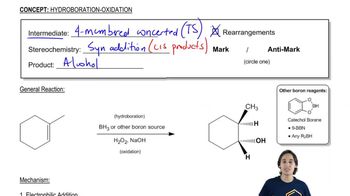
Hydroboration-Oxidation

Hydroboration-oxidation is a two-step reaction that converts alkenes into alcohols. In the first step, borane (BH₃) adds across the double bond of the alkene, resulting in a trialkylborane intermediate. The second step involves oxidation with hydrogen peroxide (H₂O₂) and a base (NaOH), which replaces the boron with a hydroxyl group, yielding an alcohol. This reaction is notable for its anti-Markovnikov selectivity, meaning the alcohol is formed at the less substituted carbon.
Recommended video:
Guided course
06:38
General properties of hydroboration-oxidation.

Stereochemistry

Stereochemistry refers to the spatial arrangement of atoms in molecules and how this affects their chemical behavior. In the context of hydroboration-oxidation, the stereochemical outcome is influenced by the mechanism of the reaction, which can lead to syn-addition of the boron and hydrogen. Understanding stereochemistry is crucial for predicting the configuration of the resulting alcohols, especially when considering the formation of chiral centers.
Recommended video:
1:38
Polymer Stereochemistry Concept 1

Alkene Selection

Choosing the appropriate alkene for hydroboration-oxidation is essential to achieve the desired alcohol product. The structure of the alkene determines the regioselectivity and stereoselectivity of the reaction. Factors such as the presence of substituents and the overall geometry of the alkene influence the outcome, making it important to analyze the target alcohols and select an alkene that will lead to their exclusive formation.
Recommended video:
2:09
Alkene Metathesis Concept 1