Ch. 9 - Alkenes II: Oxidation and Reduction
Mullins - Organic Chemistry: A Learner Centered Approach 1st Edition
Mullins1st EditionOrganic Chemistry: A Learner Centered ApproachISBN: 9780137566471Not the one you use?Change textbook
Chapter 8, Problem 44d

Determine whether the following reactions are redox reactions. If they are, identify whether the molecule has been oxidized or reduced.
(d) Cyclohexanone reduced to cyclohexanol using NaBH4 in ethanol, forming BH3 and sodium ethoxide byproducts.

Verified step by step guidance
1
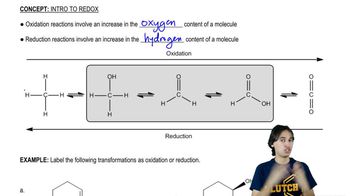
Step 1: Understand what constitutes a redox reaction. A redox (reduction-oxidation) reaction involves the transfer of electrons between two species. It consists of two half-reactions: oxidation (loss of electrons) and reduction (gain of electrons).
Step 2: Identify the oxidation states of the atoms involved in the reaction. Assign oxidation numbers to each atom in the reactants and products. This will help determine if there is a change in oxidation state, indicating a redox process.
Step 3: Compare the oxidation states of the atoms before and after the reaction. Look for any changes in oxidation numbers. An increase in oxidation number indicates oxidation, while a decrease indicates reduction.
Step 4: Determine if the reaction involves both oxidation and reduction. For a reaction to be classified as a redox reaction, there must be a simultaneous occurrence of oxidation and reduction.
Step 5: Identify the species that have been oxidized and reduced. The species whose oxidation number increases is oxidized, and the species whose oxidation number decreases is reduced.

Verified video answer for a similar problem:

This video solution was recommended by our tutors as helpful for the problem above.
Video duration:
4m
Was this helpful?

Key Concepts

Here are the essential concepts you must grasp in order to answer the question correctly.

Redox Reactions

Redox reactions, or oxidation-reduction reactions, involve the transfer of electrons between two species. One species undergoes oxidation, losing electrons, while the other undergoes reduction, gaining electrons. Identifying redox reactions requires analyzing changes in oxidation states of the involved elements.
Recommended video:
Guided course
06:02
General Features of Redox

Oxidation States

The oxidation state, or oxidation number, is a theoretical charge assigned to an atom in a molecule, representing its electron loss or gain. It helps track electron transfer in redox reactions. Changes in oxidation states indicate whether an atom has been oxidized (increase in oxidation state) or reduced (decrease in oxidation state).
Recommended video:
Guided course
03:08
Ground vs. Excited States

Identifying Oxidized and Reduced Species

To determine which species is oxidized or reduced, compare the oxidation states of each element before and after the reaction. The species whose oxidation state increases is oxidized, while the one whose oxidation state decreases is reduced. This analysis helps in understanding the electron flow and the nature of the redox process.
Recommended video:
Guided course
08:42
Reducing Sugars