Ch. 9 - Alkenes II: Oxidation and Reduction
Mullins - Organic Chemistry: A Learner Centered Approach 1st Edition
Mullins1st EditionOrganic Chemistry: A Learner Centered ApproachISBN: 9780137566471Not the one you use?Change textbook
Chapter 8, Problem 48a

In light of your answer to Assessment 9.47, predict the product of the following reactions we have seen previously where an alcohol is substituted for water.
(a)

Verified step by step guidance
1
Step 1: Analyze the reactants and reaction conditions. The starting material is an ether with a bulky tert-butyl group and a secondary alcohol group. The reaction conditions include H2SO4 (sulfuric acid), which is a strong acid, and ethanol (CH3CH2OH), which acts as a nucleophile.
Step 2: Recognize the mechanism involved. Under acidic conditions, ethers can undergo cleavage via protonation of the oxygen atom, making it more electrophilic. This leads to the formation of a carbocation intermediate.
Step 3: Predict the protonation step. The oxygen atom in the ether is protonated by H2SO4, resulting in the formation of a good leaving group (water or an alcohol group). This sets the stage for the cleavage of the ether bond.
Step 4: Consider the carbocation stability. The tert-butyl group is highly stabilizing for carbocations due to hyperconjugation and inductive effects. Therefore, the cleavage will likely result in the formation of a tert-butyl carbocation.
Step 5: Predict the nucleophilic attack. Ethanol (CH3CH2OH) will act as a nucleophile and attack the carbocation, leading to the formation of an ether product where the tert-butyl group is bonded to the ethoxy group (CH3CH2O-).

Verified video answer for a similar problem:

This video solution was recommended by our tutors as helpful for the problem above.
Video duration:
4m
Was this helpful?

Key Concepts

Here are the essential concepts you must grasp in order to answer the question correctly.

Alcohol Substitution Reactions

In organic chemistry, alcohols can undergo substitution reactions where the hydroxyl (-OH) group is replaced by another group, such as a halide or an alkyl group. This process often involves the activation of the alcohol, typically by protonation, to form a better leaving group. Understanding this concept is crucial for predicting the products of reactions involving alcohols.
Recommended video:
Guided course
01:44
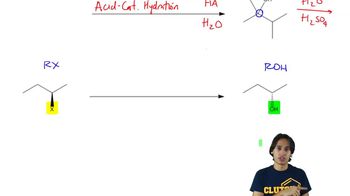
Forming alcohols through SN2 reactions.

Acid-Catalyzed Reactions

Acid-catalyzed reactions involve the use of an acid, such as sulfuric acid (H2SO4), to facilitate the reaction mechanism. In the context of alcohol substitution, the acid protonates the alcohol, enhancing its electrophilicity and making it more reactive. This concept is essential for understanding how the reaction proceeds and the role of the acid in the transformation.
Recommended video:
Guided course
03:09
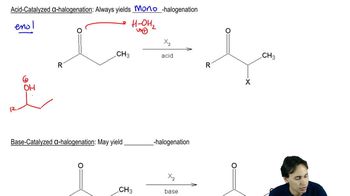
Acid Catalyzed

Mechanism of Nucleophilic Substitution

Nucleophilic substitution mechanisms, such as SN1 and SN2, describe how nucleophiles attack electrophiles to replace a leaving group. In the case of alcohol substitution, the mechanism can vary based on the structure of the substrate and the conditions of the reaction. Recognizing the type of mechanism at play helps in predicting the structure of the final product.
Recommended video:
Guided course
01:47
Nucleophiles and Electrophiles can react in Substitution Reactions.