Ch. 9 - Alkenes II: Oxidation and Reduction
Mullins - Organic Chemistry: A Learner Centered Approach 1st Edition
Mullins1st EditionOrganic Chemistry: A Learner Centered ApproachISBN: 9780137566471Not the one you use?Change textbook
Chapter 8, Problem 57

In spite of being mechanistically similar to some of the reactions we saw in Chapter 8, rearrangement never occurred here in Chapter 9. Why doesn't rearrangement occur in the following bromination reaction despite the proximity of a more substituted carbon?

Verified step by step guidance
1
Identify the type of reaction: The reaction shown is a halogenation of an alkene, specifically a bromination reaction, where Br2 is added across the double bond.
Understand the mechanism: Bromination of alkenes typically proceeds via a three-membered cyclic bromonium ion intermediate, which is a key factor in preventing rearrangement.
Consider the stability of intermediates: The bromonium ion intermediate is relatively stable and does not easily rearrange because breaking the three-membered ring to form a carbocation would be energetically unfavorable.
Analyze the potential for rearrangement: In typical carbocation rearrangements, a more stable carbocation is formed. However, in this reaction, the bromonium ion does not rearrange to form a carbocation, thus preventing any rearrangement.
Conclude why rearrangement is not observed: The presence of the stable bromonium ion intermediate and the lack of a carbocation formation step in the mechanism explain why rearrangement does not occur, even in the presence of a more substituted carbon nearby.

Verified video answer for a similar problem:

This video solution was recommended by our tutors as helpful for the problem above.
Video duration:
4m
Was this helpful?

Key Concepts

Here are the essential concepts you must grasp in order to answer the question correctly.

Bromination Mechanism

Bromination is an electrophilic addition reaction where bromine adds to a double bond. The mechanism typically involves the formation of a bromonium ion intermediate, which can lead to different pathways depending on the stability of the carbocation formed. Understanding this mechanism is crucial to analyze why rearrangement may or may not occur in specific reactions.
Recommended video:
Guided course
00:54
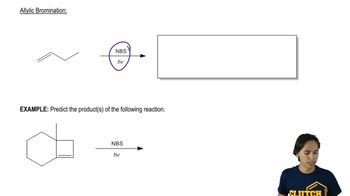
Mechanism of Allylic Bromination.

Carbocation Stability

Carbocation stability is a key factor in determining the outcome of reactions involving electrophiles. More substituted carbocations are generally more stable due to hyperconjugation and inductive effects. In the context of bromination, if the formation of a more stable carbocation is not favored, rearrangement will not occur, even if a more substituted carbon is nearby.
Recommended video:
Guided course
05:58
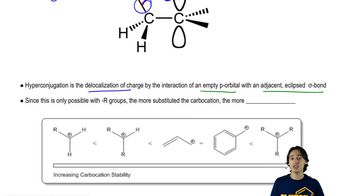
Determining Carbocation Stability

Rearrangement in Organic Reactions

Rearrangement refers to the process where a molecule undergoes a structural change to form a more stable isomer, often involving the migration of atoms or groups. In certain reactions, such as those involving carbocations, rearrangement can lead to more stable products. However, if the reaction conditions or intermediates do not favor this process, rearrangement may be suppressed, as seen in the bromination reaction discussed.
Recommended video:
Guided course
06:08
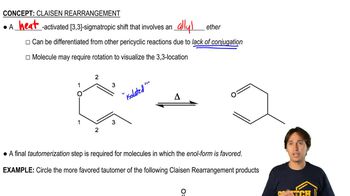
Definition of Claisen Rearrangement