Ch. 9 - Alkenes II: Oxidation and Reduction
Mullins - Organic Chemistry: A Learner Centered Approach 1st Edition
Mullins1st EditionOrganic Chemistry: A Learner Centered ApproachISBN: 9780137566471Not the one you use?Change textbook
Chapter 8, Problem 7a

Provide an arrow-pushing mechanism that rationalizes the stereospecific formation of each dihalide in Assessment 9.6.

Verified step by step guidance
1
Identify the starting alkene structure and note the stereochemistry of the double bond. This is crucial because the stereochemistry of the alkene will influence the stereospecificity of the dihalide product.
Understand the reaction mechanism: The addition of halogens (e.g., Br₂ or Cl₂) to an alkene proceeds via an anti-addition mechanism. This involves the formation of a cyclic halonium ion intermediate.
Draw the first step of the mechanism: Show the alkene reacting with the halogen molecule (e.g., Br₂). Use curved arrows to depict the π-electrons of the double bond attacking one halogen atom, while the bond between the two halogen atoms breaks, forming a halonium ion.
Illustrate the second step: The halonium ion is attacked by the halide ion (e.g., Br⁻) from the opposite side of the ring. Use curved arrows to show the nucleophilic attack and the opening of the halonium ion, leading to anti-addition of the halogen atoms.
Verify the stereochemistry of the product: Ensure that the two halogen atoms are added to opposite faces of the original alkene plane, resulting in a stereospecific dihalide product. Confirm that the stereochemistry matches the observed product in the problem.

Verified video answer for a similar problem:

This video solution was recommended by our tutors as helpful for the problem above.
Was this helpful?

Key Concepts

Here are the essential concepts you must grasp in order to answer the question correctly.

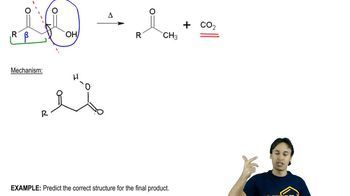
Arrow-Pushing Mechanism

Arrow-pushing mechanisms are diagrams used in organic chemistry to illustrate the movement of electrons during chemical reactions. They show how nucleophiles and electrophiles interact, indicating the flow of electrons with arrows. Understanding this mechanism is crucial for predicting the products of reactions, especially in stereospecific processes where the spatial arrangement of atoms is significant.
Recommended video:
Guided course
04:32
General Mechanism

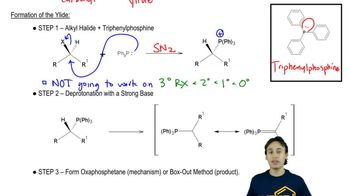
Stereospecificity

Stereospecificity refers to a reaction where the configuration of the reactant leads to a specific configuration of the product. In the context of dihalide formation, this means that the stereochemistry of the starting material directly influences the stereochemistry of the resulting dihalide. Recognizing stereospecific reactions is essential for understanding how different isomers can be selectively produced.
Recommended video:
Guided course
15:39
Box-Out Method and Full-Mechanism

Dihalide Formation

Dihalide formation involves the addition of halogen atoms to a substrate, resulting in a compound with two halogen substituents. This process can occur through various mechanisms, such as electrophilic addition or nucleophilic substitution, and can lead to different stereochemical outcomes depending on the reaction conditions and the nature of the substrate. Analyzing the formation of dihalides helps in understanding the reactivity and selectivity of organic compounds.
Recommended video:
Guided course
02:26
Formation of Enolates