Ch. 9 - Alkenes II: Oxidation and Reduction
Mullins - Organic Chemistry: A Learner Centered Approach 1st Edition
Mullins1st EditionOrganic Chemistry: A Learner Centered ApproachISBN: 9780137566471Not the one you use?Change textbook
Chapter 8, Problem 5d

Use oxidation numbers to determine which of the following are redox reactions.
(d) Chemical reaction showing tert-butylamine reacting with water to form tert-butylammonium ion and hydroxide ion.

Verified step by step guidance
1
Identify the oxidation states of each element in the reactants and products. For example, in a compound like H2O, hydrogen typically has an oxidation state of +1 and oxygen -2.
Assign oxidation numbers to each element in the given chemical equation. Remember that the sum of oxidation numbers in a neutral compound is zero, and in a polyatomic ion, it is equal to the charge of the ion.
Compare the oxidation numbers of each element in the reactants and products. Look for any changes in oxidation states.
Determine which element is oxidized and which is reduced. Oxidation involves an increase in oxidation number, while reduction involves a decrease.
Conclude whether the reaction is a redox reaction. If there is a change in oxidation numbers indicating both oxidation and reduction, it is a redox reaction.

Verified video answer for a similar problem:

This video solution was recommended by our tutors as helpful for the problem above.
Video duration:
2m
Was this helpful?

Key Concepts

Here are the essential concepts you must grasp in order to answer the question correctly.

Oxidation Numbers

Oxidation numbers are assigned to atoms in a molecule to indicate the distribution of electrons among them. They help in identifying the oxidation state of an element in a compound, which is crucial for determining electron transfer in redox reactions. The sum of oxidation numbers in a neutral compound is zero, while in ions, it equals the charge of the ion.
Recommended video:
Guided course
03:40
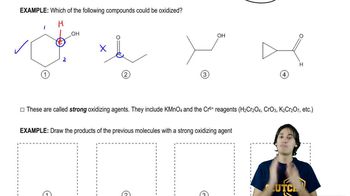
Strong oxidizing agents

Redox Reactions

Redox reactions, or oxidation-reduction reactions, involve the transfer of electrons between two species. One species undergoes oxidation (loses electrons) and the other undergoes reduction (gains electrons). Identifying changes in oxidation numbers of elements in a reaction helps determine if a redox process has occurred.
Recommended video:
Guided course
06:02
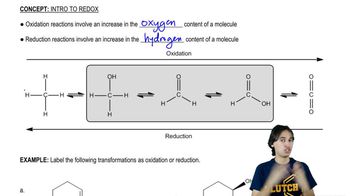
General Features of Redox

Identifying Redox Reactions

To identify redox reactions, compare the oxidation numbers of elements in the reactants and products. A change in oxidation numbers indicates a redox reaction, with an increase signifying oxidation and a decrease indicating reduction. This method is essential for distinguishing redox reactions from other types of chemical reactions.
Recommended video:
Guided course
06:02
General Features of Redox