
Ch. 22 - Conjugated Systems II: Pericyclic Reactions
Mullins - Organic Chemistry: A Learner Centered Approach 1st Edition
Mullins1st EditionOrganic Chemistry: A Learner Centered ApproachISBN: 9780137566471Not the one you use?Change textbook
Chapter 21, Problem 41b

Predict the product of the Claisen reactions shown.
(b) Chemical structure of a Claisen rearrangement reaction with a chlorinated allyl vinyl ether and heat symbol.

Verified step by step guidance
1
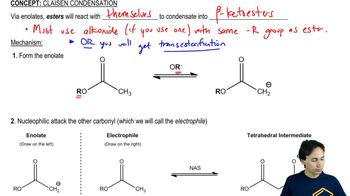
Step 1: Understand the Claisen condensation reaction. It involves the reaction between two esters or one ester and a ketone in the presence of a strong base, typically an alkoxide, to form a β-keto ester or a β-diketone.
Step 2: Identify the reactants in the given Claisen reaction. Look for the ester or ketone groups that will participate in the reaction.
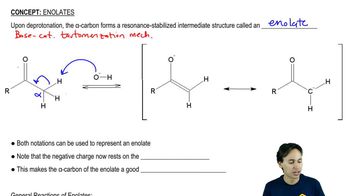
Step 3: Determine the base used in the reaction. Common bases include sodium ethoxide (NaOEt) or sodium methoxide (NaOMe). The base deprotonates the α-hydrogen of the ester, forming an enolate ion.
Step 4: Predict the nucleophilic attack. The enolate ion formed will attack the carbonyl carbon of another ester molecule, leading to the formation of a new carbon-carbon bond.
Step 5: Consider the final product formation. After the nucleophilic attack, the intermediate undergoes protonation and elimination of the alkoxide ion, resulting in the formation of a β-keto ester or β-diketone as the final product.

Verified video answer for a similar problem:

This video solution was recommended by our tutors as helpful for the problem above.
Was this helpful?

Key Concepts

Here are the essential concepts you must grasp in order to answer the question correctly.

Claisen Condensation

The Claisen condensation is a reaction where two esters or one ester and a ketone react in the presence of a strong base to form a β-keto ester or a β-diketone. This reaction involves the formation of a new carbon-carbon bond and is crucial for synthesizing complex molecules in organic chemistry.
Recommended video:
Guided course
08:28
Claisen Condensation

Enolate Ion Formation

Enolate ions are formed when a strong base deprotonates the α-hydrogen of an ester or ketone, creating a resonance-stabilized anion. This enolate ion acts as a nucleophile in the Claisen condensation, attacking the carbonyl carbon of another ester, leading to the formation of the product.
Recommended video:
Guided course
02:26
Formation of Enolates

Acid Workup

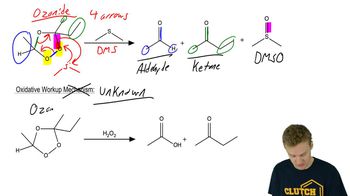
After the Claisen condensation, an acid workup is typically performed to neutralize the reaction mixture and protonate the alkoxide intermediate, resulting in the final β-keto ester or β-diketone product. This step is essential to stabilize the product and complete the reaction process.
Recommended video:
Guided course
01:31
Oxidative Workup Mechanism: