Ch. 22 - Conjugated Systems II: Pericyclic Reactions
Mullins - Organic Chemistry: A Learner Centered Approach 1st Edition
Mullins1st EditionOrganic Chemistry: A Learner Centered ApproachISBN: 9780137566471Not the one you use?Change textbook
Chapter 21, Problem 39c

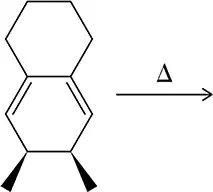
Draw the products you’d expect to form in Assessment 22.38.
(c) Chemical structure illustrating a thermal electrocyclic reaction with a triangle symbol indicating the expected product formation.

Verified step by step guidance
1
Identify the starting material: The structure shown is a bicyclic compound with two fused cyclohexene rings, also known as a bicyclo[2.2.2]octadiene system.
Recognize the reaction conditions: The presence of a delta symbol (Δ) indicates that the reaction involves heat, suggesting a pericyclic reaction such as a Diels-Alder or a Cope rearrangement.
Consider possible reactions: Given the structure and conditions, a Cope rearrangement is likely. This involves a [3,3]-sigmatropic shift, where the pi bonds and sigma bonds rearrange to form a new structure.
Predict the product structure: In a Cope rearrangement, the double bonds will shift positions. The two double bonds in the bicyclic system will move to form a new set of double bonds, resulting in a different bicyclic structure.
Draw the expected product: The new structure will have the double bonds in different positions compared to the starting material, maintaining the bicyclic framework but altering the connectivity of the pi bonds.

Verified video answer for a similar problem:

This video solution was recommended by our tutors as helpful for the problem above.
Was this helpful?

Key Concepts

Here are the essential concepts you must grasp in order to answer the question correctly.

Electrocyclic Reactions

Electrocyclic reactions are a type of pericyclic reaction where a conjugated pi-electron system undergoes a cyclic reorganization to form a sigma bond. These reactions are typically influenced by thermal or photochemical conditions, leading to the formation of cyclic compounds. The stereochemistry of the product is determined by the conrotatory or disrotatory motion of the substituents during the reaction.
Recommended video:
Guided course
08:11
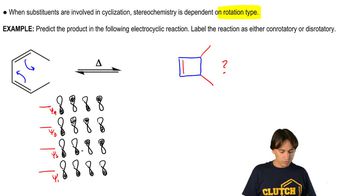
Predicting Electrocyclic Products

Thermal Activation

Thermal activation in organic chemistry refers to the use of heat to provide the energy necessary for a chemical reaction to occur. In the context of electrocyclic reactions, thermal conditions often dictate the stereochemical outcome, such as conrotatory or disrotatory ring closure, based on the number of pi electrons involved, following the Woodward-Hoffmann rules.
Recommended video:
Guided course
06:36
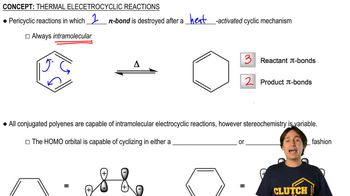
MO Theory of Thermal Electrocyclics

Woodward-Hoffmann Rules

The Woodward-Hoffmann rules are a set of principles used to predict the stereochemistry of pericyclic reactions, including electrocyclic reactions. These rules state that the stereochemical outcome (conrotatory or disrotatory) depends on the number of pi electrons and whether the reaction is thermally or photochemically driven. For thermal reactions, systems with 4n pi electrons undergo conrotatory closure, while those with 4n+2 pi electrons undergo disrotatory closure.
Recommended video:
1:18
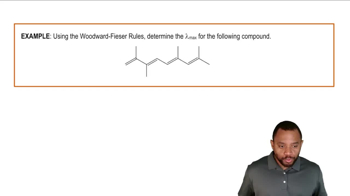
Woodward-Fieser Rules Example 1