Ch. 3 - Alkanes and Cycloalkanes: Properties and Conformational Analysis
Mullins - Organic Chemistry: A Learner Centered Approach 1st Edition
Mullins1st EditionOrganic Chemistry: A Learner Centered ApproachISBN: 9780137566471Not the one you use?Change textbook
Chapter 2, Problem 60g

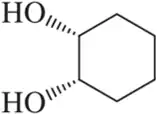
For each structure shown, draw the two chair conformations and choose which is most stable. Be sure that your second chair is the flipped version of the first. [Make sure that wedged substituents are up in the chair, regardless of whether up is equatorial or axial.]
(g) Chemical structure of a cyclohexane with two hydroxyl (OH) groups attached, illustrating chair conformations.

Verified step by step guidance
1
Step 1: Understand the chair conformation of cyclohexane. Cyclohexane adopts a chair conformation to minimize steric strain and torsional strain. In this conformation, substituents can occupy either axial (vertical) or equatorial (angled) positions.
Step 2: Analyze the given structure and identify the substituents. Determine whether the substituents are wedged (up) or dashed (down). Remember that wedged substituents are always positioned 'up' in the chair conformation, regardless of whether they are axial or equatorial.
Step 3: Draw the first chair conformation. Place the substituents on the appropriate positions (axial or equatorial) based on their orientation (up or down). Ensure that the cyclohexane ring is drawn in the correct chair form.
Step 4: Perform a ring flip to draw the second chair conformation. A ring flip interchanges axial and equatorial positions for all substituents while maintaining their 'up' or 'down' orientation. Redraw the cyclohexane ring in the flipped chair form and reposition the substituents accordingly.
Step 5: Compare the two chair conformations for stability. The most stable conformation minimizes steric hindrance, which typically occurs when bulky substituents occupy equatorial positions. Evaluate the positions of the substituents in both conformations and choose the more stable one.

Verified video answer for a similar problem:

This video solution was recommended by our tutors as helpful for the problem above.
Video duration:
7m
Was this helpful?

Key Concepts

Here are the essential concepts you must grasp in order to answer the question correctly.

Chair Conformation

The chair conformation is a three-dimensional representation of cyclohexane that minimizes steric strain and torsional strain. In this conformation, carbon atoms are arranged in a staggered manner, allowing for more stable interactions between substituents. Understanding how to draw and visualize chair conformations is crucial for analyzing the stability of cyclohexane derivatives.
Recommended video:
Guided course
03:29
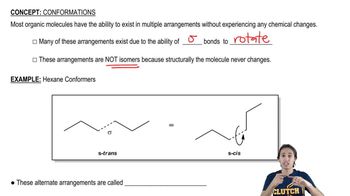
Understanding what a conformer is.

Axial and Equatorial Positions

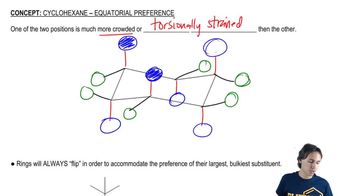
In the chair conformation, substituents can occupy two types of positions: axial (pointing up or down, perpendicular to the ring) and equatorial (pointing outward, parallel to the ring). The stability of a molecule is influenced by the positioning of substituents; larger groups prefer equatorial positions to minimize steric hindrance with other axial substituents. Recognizing these positions is essential for determining the most stable conformation.
Recommended video:
Guided course
04:02
Equatorial Preference

Conformational Analysis

Conformational analysis involves evaluating the different spatial arrangements of a molecule and their relative stabilities. For cyclohexane derivatives, this includes comparing chair conformations and identifying which arrangement minimizes steric interactions and torsional strain. This analysis is key to predicting the most stable conformation based on the substituents' sizes and orientations.
Recommended video:
Guided course
03:29
Understanding what a conformer is.
Related Practice
Textbook Question

Calculate the energy difference between each pair of conformations shown by drawing and comparing Newman projections down the indicated bonds in each.

(b)

1229
views

Textbook Question

For each pair of conformations shown, choose which is most stable. If both are equally stable, then write 'no difference.' [If both conformations have the same number of axial substituents, choose the one with the smallest axial substituents.]

(e)

1001
views
Textbook Question

For each pair of conformations shown, choose which is most stable. If both are equally stable, then write 'no difference.' [If both conformations have the same number of axial substituents, choose the one with the smallest axial substituents.]

(g)

1122
views
Textbook Question

In contrast to ethane and other alkanes studied in this chapter, there is no free rotation around any bonds in cyclopentane (shown below). Why?

1117
views
Textbook Question

Looking ahead In Chapter 5, we explain that the equilibrium constant (Keq) for a reaction can be calculated based on the difference in energy between reactants and products, according to the following equation:

Keq=eΔERTK_{eq}=e^{-\(\frac{\Delta E}{RT}\)}

Using this equation, calculate the equilibrium constant for the 'reaction' shown. [For the rest of the book, if not otherwise specified, assume room temperature (298K).]

1295
views
1
rank
Textbook Question

For each structure shown, draw the two chair conformations and choose which is most stable. Be sure that your second chair is the flipped version of the first. [Make sure that wedged substituents are up in the chair, regardless of whether up is equatorial or axial.]

(e)

1557
views