Ch. 11 - Properties and Synthesis of Alkyl Halides: Radical Reactions
Mullins - Organic Chemistry: A Learner Centered Approach 1st Edition
Mullins1st EditionOrganic Chemistry: A Learner Centered ApproachISBN: 9780137566471Not the one you use?Change textbook
Chapter 10, Problem 43a

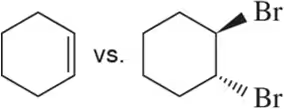
In each pair, choose the compound you would expect to have the highest boiling/melting point.
(a) Two hexagonal chemical structures, one with a double bond and one with a bromine substituent, labeled "vs."

Verified step by step guidance
1
Step 1: Understand the factors that influence boiling and melting points. These include intermolecular forces (such as hydrogen bonding, dipole-dipole interactions, and London dispersion forces), molecular weight, and molecular structure (e.g., branching in hydrocarbons).
Step 2: Analyze the compounds in the pair provided. Identify the functional groups, molecular weight, and type of intermolecular forces present in each compound.
Step 3: Compare the strength of intermolecular forces between the two compounds. For example, compounds with hydrogen bonding typically have higher boiling/melting points than those with only dipole-dipole or London dispersion forces.
Step 4: Consider molecular weight and structure. Larger molecules or those with less branching tend to have higher boiling/melting points due to increased surface area for intermolecular interactions.
Step 5: Based on the analysis, determine which compound in the pair has the stronger intermolecular forces, higher molecular weight, or less branching, and conclude that it will have the higher boiling/melting point.

Verified video answer for a similar problem:

This video solution was recommended by our tutors as helpful for the problem above.
Video duration:
3m
Was this helpful?

Key Concepts

Here are the essential concepts you must grasp in order to answer the question correctly.

Intermolecular Forces

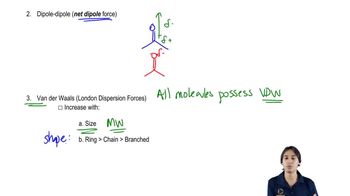
Intermolecular forces are the attractive forces between molecules that influence physical properties like boiling and melting points. The main types include hydrogen bonding, dipole-dipole interactions, and London dispersion forces. Compounds with stronger intermolecular forces generally exhibit higher boiling and melting points due to the increased energy required to overcome these attractions.
Recommended video:
Guided course
03:01
How Van der Waals forces work.

Molecular Weight

Molecular weight, or molar mass, refers to the mass of a molecule based on the sum of the atomic weights of its constituent atoms. Generally, compounds with higher molecular weights have higher boiling and melting points because larger molecules have more electrons, leading to stronger London dispersion forces. This trend is particularly evident in nonpolar compounds.
Recommended video:
Guided course
08:41
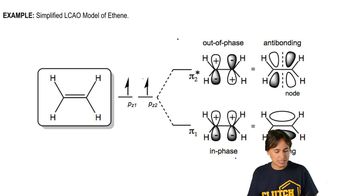
Review of Molecular Orbitals

Functional Groups

Functional groups are specific groups of atoms within molecules that are responsible for the characteristic chemical reactions of those molecules. Different functional groups can significantly affect the boiling and melting points of compounds. For example, alcohols, which contain hydroxyl (-OH) groups, typically have higher boiling points than hydrocarbons of similar molecular weight due to hydrogen bonding.
Recommended video:
Guided course
02:36
Identifying Functional Groups