The bromoalkanes shown below participate in SN1 reactions with the relative rates shown. Explain this trend. relative rate:
Ch. 12 - Substitution and Elimination: Reactions of Haloalkanes

Mullins1st EditionOrganic Chemistry: A Learner Centered ApproachISBN: 9780137566471Not the one you use?Change textbook
All textbooks
Mullins 1st Edition
Ch. 12 - Substitution and Elimination: Reactions of Haloalkanes
Problem 75
Mullins 1st Edition
Ch. 12 - Substitution and Elimination: Reactions of Haloalkanes
Problem 75Chapter 11, Problem 75
In this, and previous, chapters, we have seen 1,2-alkyl and 1,2-hydride shifts. If both are possible, as in the carbocation shown, which would you expect to occur? Explain your answer.

Verified step by step guidance1
Step 1: Analyze the carbocation structure shown in the image. The carbocation is located on a secondary carbon, and there are two possible shifts: a 1,2-hydride shift (path a) and a 1,2-alkyl shift (path b).
Step 2: Understand the purpose of these shifts. Both shifts aim to stabilize the carbocation by moving the positive charge to a more stable position. Stability increases as we move from secondary to tertiary carbocations.
Step 3: Evaluate the 1,2-hydride shift (path a). This shift involves the migration of a hydrogen atom with its bonding electrons to the carbocation center. If this shift results in a tertiary carbocation, it is likely to occur because tertiary carbocations are more stable than secondary ones.
Step 4: Evaluate the 1,2-alkyl shift (path b). This shift involves the migration of an alkyl group with its bonding electrons to the carbocation center. If this shift also results in a tertiary carbocation, it could compete with the hydride shift. However, hydride shifts are generally faster and more favorable due to lower steric hindrance.
Step 5: Conclude that the 1,2-hydride shift (path a) is expected to occur because it is typically faster and leads to a more stable tertiary carbocation. The 1,2-alkyl shift (path b) is less likely unless it provides an even greater stabilization or is sterically favored.

Verified video answer for a similar problem:
This video solution was recommended by our tutors as helpful for the problem above.
Was this helpful?
Key Concepts
Here are the essential concepts you must grasp in order to answer the question correctly.
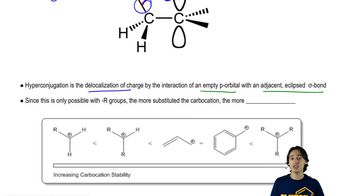
Carbocation Stability
Carbocations are positively charged species that are highly reactive due to the electron deficiency at the positively charged carbon atom. Their stability is influenced by the degree of substitution; tertiary carbocations are more stable than secondary or primary ones due to hyperconjugation and inductive effects from adjacent alkyl groups. Understanding the stability of carbocations is crucial for predicting the preferred rearrangement pathway.
Recommended video:
Guided course
Determining Carbocation Stability
1,2-Alkyl and 1,2-Hydride Shifts
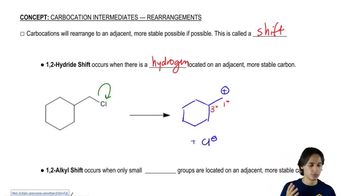
1,2-alkyl shifts involve the migration of an alkyl group from one carbon to an adjacent carbocation, while 1,2-hydride shifts involve the migration of a hydrogen atom. These shifts occur to stabilize the carbocation by forming a more stable carbocation. The preference for one shift over the other depends on the resulting carbocation's stability and the steric and electronic factors involved.
Recommended video:
Guided course
Hydride Shift
Rearrangement Mechanism
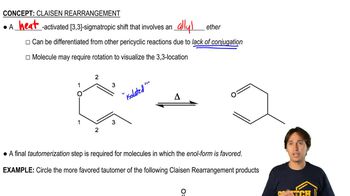
Rearrangement mechanisms in organic chemistry describe how carbocations can undergo structural changes to achieve greater stability. This process often involves the migration of groups or atoms, such as hydrides or alkyl groups, to form a more stable carbocation. The mechanism is influenced by factors such as sterics, electronic effects, and the overall energy of the transition state, which ultimately determines the favored pathway.
Recommended video:
Guided course
Definition of Claisen Rearrangement
Related Practice
Textbook Question
1137
views
Textbook Question
Suggest a mechanism for the following reactions.
(b) Substitution :
920
views
Textbook Question
Suggest a mechanism for the following reactions.
(a) Substitution:
889
views
Textbook Question
Of the three possible elimination mechanisms (Figure 12.50), this chapter focused on two of them (E1 and E2). The third possibility occurs in situations like the one below. What makes this mechanism favored under these conditions?
341
views
Textbook Question
In Chapter 8, we learned about the chemistry of terpenes and the interesting reactions they can undergo. One such reaction is the acid-catalyzed conversion of nerol to terpineol. Suggest a mechanism for this transformation
.
1390
views
Textbook Question
Suggest a mechanism for the following reactions.
(c) Elimination:
1153
views