Ch. 3 - Alkanes and Cycloalkanes: Properties and Conformational Analysis
Mullins - Organic Chemistry: A Learner Centered Approach 1st Edition
Mullins1st EditionOrganic Chemistry: A Learner Centered ApproachISBN: 9780137566471Not the one you use?Change textbook
Chapter 2, Problem 56

Using the numbers shown in the chair conformation on the left, label the carbons of the flipped chair on the right. [Assume that the angle through which you view the chair conformation doesn't change.] 

Verified step by step guidance
1
Step 1: Understand the chair flip process. In a chair flip, the axial positions become equatorial, and the equatorial positions become axial. The numbering of carbons remains consistent, but the spatial arrangement changes.
Step 2: Identify the numbering of the carbons in the original chair conformation. The carbons are numbered sequentially from 1 to 6, as shown in the left structure.
Step 3: Visualize the flipped chair conformation. The flipped chair conformation on the right is essentially the same molecule viewed from a different perspective, with the positions of the carbons rearranged.
Step 4: Assign the numbers to the carbons in the flipped chair conformation. Carbon 1 in the original conformation corresponds to the same carbon in the flipped conformation, but its position changes. Similarly, follow the sequence for carbons 2 through 6, ensuring the numbering remains consistent.
Step 5: Verify the numbering by ensuring that the connectivity and relative positions of the carbons match the original structure. This ensures that the molecule remains the same despite the flip.

Verified video answer for a similar problem:

This video solution was recommended by our tutors as helpful for the problem above.
Was this helpful?

Key Concepts

Here are the essential concepts you must grasp in order to answer the question correctly.

Chair Conformation

The chair conformation is a three-dimensional representation of cyclohexane that minimizes steric strain and torsional strain. In this conformation, the carbon atoms are arranged in a staggered manner, allowing for optimal bond angles of approximately 109.5 degrees. Understanding this structure is crucial for visualizing how substituents on the cyclohexane ring can affect stability and reactivity.
Recommended video:
Guided course
03:29
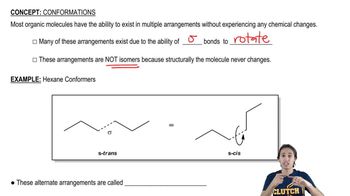
Understanding what a conformer is.

Flipping the Chair

Flipping the chair refers to the process of converting one chair conformation of cyclohexane into another by rotating the ring. This involves changing the positions of axial and equatorial substituents, which can significantly impact the molecule's stability. Recognizing how to label the carbons after a flip is essential for understanding the spatial arrangement of substituents.
Recommended video:
Guided course
05:12
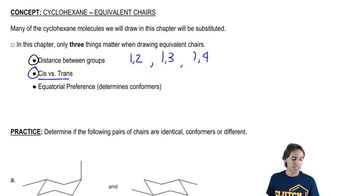
The 3 important factors when drawing chairs

Carbon Labeling

Carbon labeling in cyclohexane involves assigning numbers to each carbon atom in the ring to track their positions during conformational changes. This systematic approach helps in identifying which carbon corresponds to which substituent after a chair flip. Accurate labeling is vital for analyzing the effects of substituents on the molecule's properties and behavior.
Recommended video:
Guided course
02:12
Carbonation of Grignard Reagents
Related Practice
Textbook Question

For each chair on the left, place the substituents on the flipped chair. [Recall that the axial/equatorial designation changes from one chair to the next, but the carbon to which the substituent is attached does not.]

(c)

646
views

Textbook Question

For each chair on the left, place the substituents on the flipped chair. [Recall that the axial/equatorial designation changes from one chair to the next, but the carbon to which the substituent is attached does not.]

(f)

953
views
Textbook Question

For each pair of conformations shown, choose which is most stable. [If both conformations have the same number of gauche interactions, choose the one where the interactions are between smaller groups.]

(f)

1179
views
Textbook Question

For each chair on the left, place the substituents on the flipped chair. [Recall that the axial/equatorial designation changes from one chair to the next, but the carbon to which the substituent is attached does not.]

(e)

741
views
Textbook Question

Looking down the indicated bond, show the three most stable conformations and choose the one that is most stable. Be sure that the first Newman projection you show is the one you see initially (before rotation). [Why should none of your three Newman projections show eclipsed conformations?]

(b) <IMAGE>

1143
views
Textbook Question

Looking down the indicated bond, show the three most stable conformations and choose the one that is most stable. Be sure that the first Newman projection you show is the one you see initially (before rotation). [Why should none of your three Newman projections show eclipsed conformations?]

(e) <IMAGE>

982
views