Ch. 3 - Alkanes and Cycloalkanes: Properties and Conformational Analysis
Mullins - Organic Chemistry: A Learner Centered Approach 1st Edition
Mullins1st EditionOrganic Chemistry: A Learner Centered ApproachISBN: 9780137566471Not the one you use?Change textbook
Chapter 2, Problem 57f

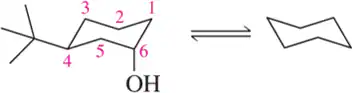
For each chair on the left, place the substituents on the flipped chair. [Recall that the axial/equatorial designation changes from one chair to the next, but the carbon to which the substituent is attached does not.]
(f) Diagram showing two chair conformations of a cyclohexane with numbered substituents and an -OH group, illustrating chair flip.

Verified step by step guidance
1
Identify the substituents on the original chair conformation and note their positions (axial or equatorial) and the specific carbon atoms they are attached to.
Recall that when a chair conformation flips, axial substituents become equatorial, and equatorial substituents become axial. However, the substituents remain attached to the same carbon atoms.
Redraw the flipped chair conformation, ensuring that the numbering of the carbon atoms remains consistent with the original chair conformation.
Place each substituent on the flipped chair conformation, switching its position from axial to equatorial or vice versa, while keeping it attached to the same carbon atom.
Double-check the flipped chair conformation to ensure that all substituents are correctly placed and that the axial/equatorial designations have been properly switched.

Verified video answer for a similar problem:

This video solution was recommended by our tutors as helpful for the problem above.
Video duration:
5m
Was this helpful?

Key Concepts

Here are the essential concepts you must grasp in order to answer the question correctly.

Chair Conformation

Chair conformation is a three-dimensional representation of cyclohexane that minimizes steric strain. In this conformation, the carbon atoms are arranged in a staggered manner, allowing for more stable interactions between substituents. Understanding chair conformation is crucial for predicting the stability of different substituent arrangements in cyclohexane derivatives.
Recommended video:
Guided course
03:29
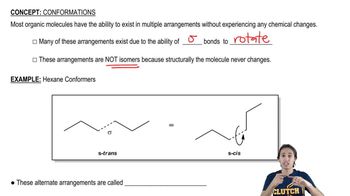
Understanding what a conformer is.

Axial and Equatorial Positions

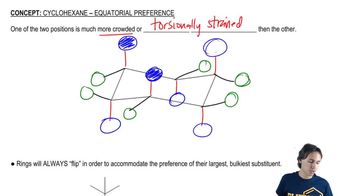
In chair conformations, substituents can occupy two distinct positions: axial and equatorial. Axial substituents are oriented perpendicular to the plane of the ring, while equatorial substituents are oriented parallel to the plane. The stability of a cyclohexane derivative is influenced by the position of its substituents, with equatorial positions generally being more favorable due to reduced steric hindrance.
Recommended video:
Guided course
04:02
Equatorial Preference

Flipping the Chair

Flipping the chair refers to the process of converting one chair conformation of cyclohexane to another, which involves inverting the positions of axial and equatorial substituents. This transformation is essential for understanding how substituents will interact in different conformations and is key to predicting the most stable arrangement of substituents in a given molecule.
Recommended video:
Guided course
05:12
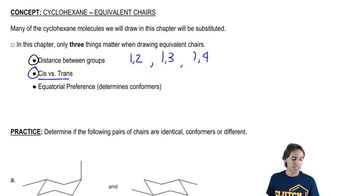
The 3 important factors when drawing chairs
Related Practice
Textbook Question

What is the mistake that was made in drawing each of the flipped chairs on the right from the chair on the left? [In these, assume that the angle through which you view the chair conformations doesn't change.]

(a)

1123
views

Textbook Question

For each chair on the left, place the substituents on the flipped chair. [Recall that the axial/equatorial designation changes from one chair to the next, but the carbon to which the substituent is attached does not.]

(c)

646
views
Textbook Question

Using the numbers shown in the chair conformation on the left, label the carbons of the flipped chair on the right. [Assume that the angle through which you view the chair conformation doesn't change.] 

1451
views
Textbook Question

For each pair of conformations shown, choose which is most stable. If both are equally stable, then write 'no difference.' [If both conformations have the same number of axial substituents, choose the one with the smallest axial substituents.]

(e)

1001
views
Textbook Question

For each pair of conformations shown, choose which is most stable. If both are equally stable, then write 'no difference.' [If both conformations have the same number of axial substituents, choose the one with the smallest axial substituents.]

(g)

1122
views
Textbook Question

For each chair on the left, place the substituents on the flipped chair. [Recall that the axial/equatorial designation changes from one chair to the next, but the carbon to which the substituent is attached does not.]

(e)

741
views