Ch. 3 - Alkanes and Cycloalkanes: Properties and Conformational Analysis
Mullins - Organic Chemistry: A Learner Centered Approach 1st Edition
Mullins1st EditionOrganic Chemistry: A Learner Centered ApproachISBN: 9780137566471Not the one you use?Change textbook
Chapter 2, Problem 26a

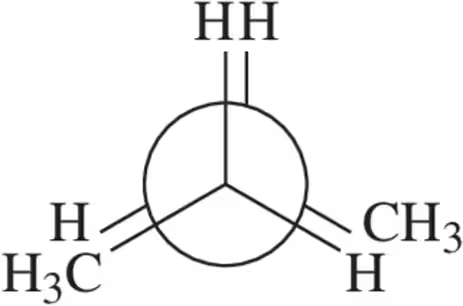
Calculate the total strain in the eclipsed conformations shown.
(a) Structural diagram of a cycloalkane showing eclipsed conformations with hydrogen and methyl groups.

Verified step by step guidance
1
Identify the type of strain present in the eclipsed conformation. Eclipsed conformations experience torsional strain due to the alignment of bonds and steric strain due to the proximity of bulky groups.
Examine the interactions between the groups in the eclipsed conformation. In the given structure, there are three pairs of eclipsed interactions: (1) H-H, (2) CH3-H, and (3) CH3-H.
Determine the strain energy associated with each type of interaction. For H-H eclipsed interactions, the torsional strain is typically 4.0 kJ/mol. For CH3-H eclipsed interactions, the torsional strain is typically 6.0 kJ/mol.
Add the strain energies for all interactions to calculate the total strain. Sum the contributions from the H-H interaction and the two CH3-H interactions.
Ensure the units are consistent and verify the calculation process. The total strain energy is the sum of the individual strain energies from the eclipsed interactions.

Verified video answer for a similar problem:

This video solution was recommended by our tutors as helpful for the problem above.
Was this helpful?

Key Concepts

Here are the essential concepts you must grasp in order to answer the question correctly.

Conformational Strain

Conformational strain refers to the energy increase associated with the spatial arrangement of atoms in a molecule. In eclipsed conformations, atoms or groups are aligned with each other, leading to increased steric hindrance and torsional strain. Understanding this concept is crucial for calculating the total strain in different conformations.
Recommended video:
Guided course
02:00
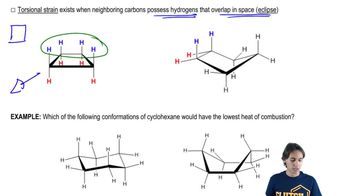
What is torsional strain?

Eclipsed vs. Staggered Conformations

Eclipsed conformations occur when atoms or groups are directly aligned with each other, resulting in higher energy states due to increased repulsion. In contrast, staggered conformations have groups positioned at angles to each other, minimizing strain. Recognizing the differences between these conformations is essential for analyzing strain in molecular structures.
Recommended video:
Guided course
03:29
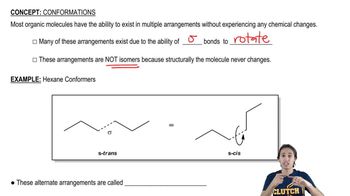
Understanding what a conformer is.

Torsional Strain

Torsional strain arises from the resistance to rotation about a bond due to eclipsing interactions between adjacent atoms or groups. This strain is particularly significant in eclipsed conformations, where the overlap of electron clouds leads to increased energy. Calculating torsional strain is vital for determining the overall stability of a molecule in different conformations.
Recommended video:
Guided course
02:00
What is torsional strain?