Ch. 17 - Carbonyl Addition Reactions: Aldehydes and Ketones
Mullins - Organic Chemistry: A Learner Centered Approach 1st Edition
Mullins1st EditionOrganic Chemistry: A Learner Centered ApproachISBN: 9780137566471Not the one you use?Change textbook
Chapter 16, Problem 26a

Suggest the appropriate carbonyl and Wittig reagent to make the following alkenes.
a. (E)-7-methylnon-4-en-3-one

Verified step by step guidance
1
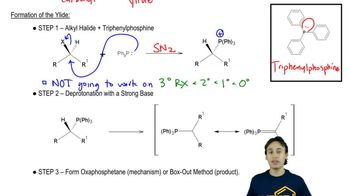
Step 1: Understand the Wittig reaction, which involves the reaction of a phosphonium ylide with a carbonyl compound to form an alkene. The ylide is typically formed from a triphenylphosphine and an alkyl halide.
Step 2: Identify the target alkene structure, (E)-7-methylnon-4-en-3-one. Note the position of the double bond and the stereochemistry (E configuration).
Step 3: Determine the carbonyl compound needed. The Wittig reaction forms the double bond at the site of the carbonyl group. For (E)-7-methylnon-4-en-3-one, the carbonyl group should be at the 3-position, suggesting the use of 3-oxononanal as the carbonyl compound.
Step 4: Identify the Wittig reagent. The Wittig reagent should provide the remaining carbon chain that forms the alkene. For (E)-7-methylnon-4-en-3-one, the Wittig reagent should be a phosphonium ylide derived from 4-methylbutyltriphenylphosphonium bromide.
Step 5: Consider the stereochemistry. The (E) configuration indicates that the Wittig reaction should be controlled to favor the trans product. This can be influenced by the choice of base and reaction conditions.

Verified video answer for a similar problem:

This video solution was recommended by our tutors as helpful for the problem above.
Video duration:
4m
Was this helpful?

Key Concepts

Here are the essential concepts you must grasp in order to answer the question correctly.

Wittig Reaction

The Wittig reaction is a chemical reaction used to convert carbonyl compounds, such as aldehydes and ketones, into alkenes. This transformation involves the reaction of a phosphonium ylide with a carbonyl compound, resulting in the formation of a new carbon-carbon double bond. Understanding the mechanism and the stereochemistry of the Wittig reaction is crucial for predicting the structure of the resulting alkene.
Recommended video:
Guided course
15:39
Box-Out Method and Full-Mechanism

Carbonyl Compounds

Carbonyl compounds are organic molecules that contain a carbon-oxygen double bond. They are key intermediates in many organic reactions, including the Wittig reaction. In the context of synthesizing alkenes, selecting the appropriate carbonyl compound is essential, as it determines the position and configuration of the double bond in the final alkene product.
Recommended video:
Guided course
01:40
Defining meso compounds.

Stereochemistry of Alkenes

Stereochemistry refers to the spatial arrangement of atoms in molecules and its impact on the physical and chemical properties of compounds. In alkenes, stereochemistry is particularly important because it affects the E/Z configuration of the double bond. For the synthesis of (E)-7-methylnon-4-en-3-one, understanding how to control and predict the stereochemistry during the Wittig reaction is crucial for obtaining the desired (E)-isomer.
Recommended video:
1:38
Polymer Stereochemistry Concept 1