Ch. 2 - General Chemistry Translated: Finding the Electrons
Mullins - Organic Chemistry: A Learner Centered Approach 1st Edition
Mullins1st EditionOrganic Chemistry: A Learner Centered ApproachISBN: 9780137566471Not the one you use?Change textbook
Chapter 1, Problem 15d

How many electrons does an atom of each of the following elements need to gain to achieve a noble gas configuration? By gaining that many electrons, which noble gas configuration is achieved?
(d) Chlorine

Verified step by step guidance
1
Determine the group number of chlorine in the periodic table. Chlorine is in Group 17 (halogens), which means it has 7 valence electrons.
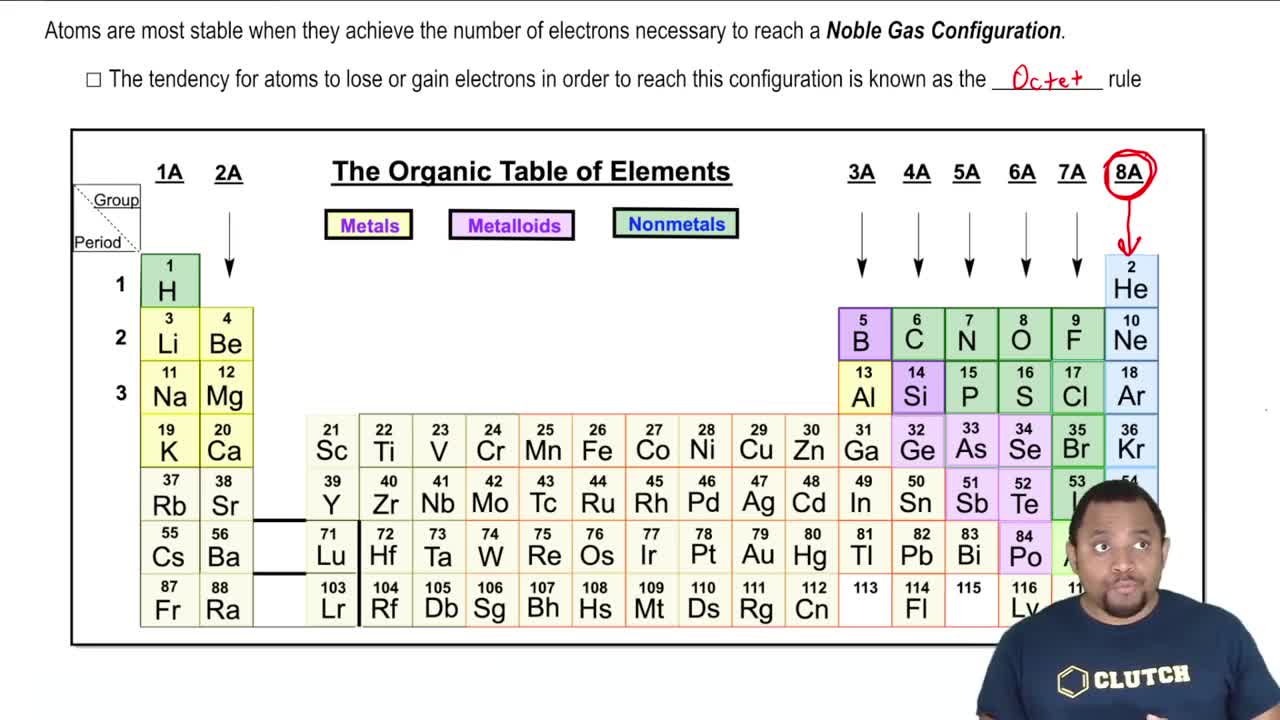
Recall that a noble gas configuration corresponds to a full outer shell of electrons. For most elements, this means achieving 8 valence electrons (the octet rule).
Calculate how many electrons chlorine needs to gain to reach 8 valence electrons. Since chlorine has 7 valence electrons, it needs to gain 1 electron.
Identify the noble gas configuration achieved by gaining 1 electron. Chlorine (atomic number 17) will have 18 electrons after gaining 1 electron, which corresponds to the electron configuration of argon (atomic number 18).
Conclude that chlorine needs to gain 1 electron to achieve the noble gas configuration of argon.

Verified video answer for a similar problem:

This video solution was recommended by our tutors as helpful for the problem above.
Video duration:
2m
Was this helpful?

Key Concepts

Here are the essential concepts you must grasp in order to answer the question correctly.

Noble Gas Configuration

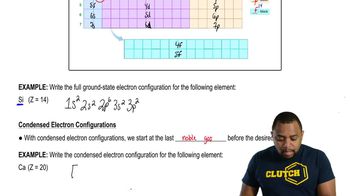
Noble gas configuration refers to the electron arrangement of noble gases, which have full outer electron shells, making them stable and unreactive. Atoms tend to gain, lose, or share electrons to achieve this stable configuration, typically resembling that of the nearest noble gas in the periodic table.
Recommended video:
Guided course
02:14
The Electron Configuration

Electron Affinity

Electron affinity is the energy change that occurs when an atom gains an electron. Elements with high electron affinity, like chlorine, readily accept electrons to achieve a stable electron configuration, often resulting in the formation of negative ions (anions) that correspond to noble gas configurations.
Recommended video:
Guided course
03:54
The 18 and 16 Electron Rule

Periodic Table Trends

Periodic table trends refer to the predictable patterns observed in the properties of elements, such as electronegativity, ionization energy, and electron affinity. Understanding these trends helps in predicting how many electrons an element will gain or lose to achieve a noble gas configuration, particularly for nonmetals like chlorine.
Recommended video:
Guided course
02:24
The most important parts of the periodic table for organic chemistry