Ch. 2 - General Chemistry Translated: Finding the Electrons
Mullins - Organic Chemistry: A Learner Centered Approach 1st Edition
Mullins1st EditionOrganic Chemistry: A Learner Centered ApproachISBN: 9780137566471Not the one you use?Change textbook
Chapter 1, Problem 16c

Give the charge most likely to result from ionization of the following metals.
(c) Potassium

Verified step by step guidance
1
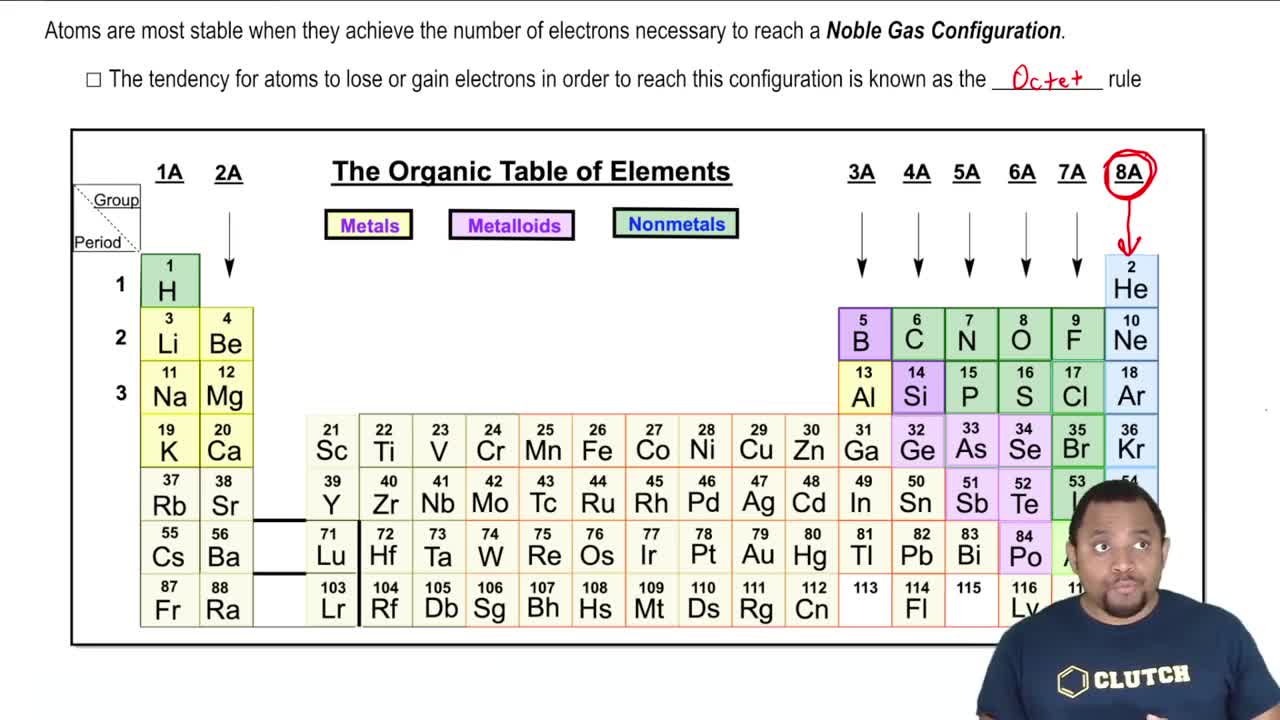
Identify the group of the periodic table where potassium (K) is located. Potassium is an alkali metal, which belongs to Group 1 of the periodic table.
Recall that elements in Group 1 have one valence electron in their outermost shell. This electron is relatively easy to lose during ionization because it is weakly held by the nucleus.
Understand that when potassium loses its single valence electron, it achieves a stable electron configuration similar to the nearest noble gas, argon (Ar). This is known as the octet rule.
Write the ionization process for potassium: K → K⁺ + e⁻. Here, potassium loses one electron to form a positively charged ion (cation) with a +1 charge.
Conclude that the most likely charge resulting from the ionization of potassium is +1, as this is the stable state achieved by losing its single valence electron.

Verified video answer for a similar problem:

This video solution was recommended by our tutors as helpful for the problem above.
Was this helpful?

Key Concepts

Here are the essential concepts you must grasp in order to answer the question correctly.

Ionization Energy

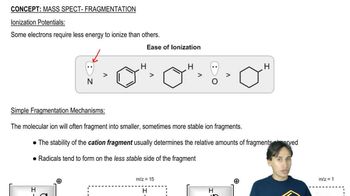
Ionization energy is the energy required to remove an electron from an atom or ion. For metals, this energy is typically lower, allowing them to lose electrons easily and form positive ions. Understanding ionization energy helps predict how readily a metal will ionize and the charge of the resulting ion.
Recommended video:
Guided course
04:28
Ionization Potentials

Cation Formation

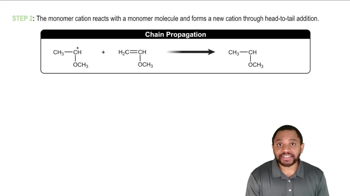
Cation formation refers to the process by which an atom loses one or more electrons, resulting in a positively charged ion. Metals, such as potassium, tend to lose their outermost electron to achieve a stable electron configuration, often resembling that of the nearest noble gas. This process is crucial for determining the charge of the ion formed.
Recommended video:
0:52
Cationic Polymerization Concept 3

Group Trends in the Periodic Table

The periodic table is organized into groups, which share similar chemical properties. Potassium is in Group 1 (alkali metals), which typically have a +1 charge when ionized. Recognizing these group trends allows for predicting the charge of ions formed by elements based on their position in the periodic table.
Recommended video:
Guided course
02:24
The most important parts of the periodic table for organic chemistry