Imidazole is a heteroaromatic base. Which nitrogen, a or b, is most basic?
Ch. 23 - Benzene I: Aromatic Stability and Substitution Reactions

Mullins1st EditionOrganic Chemistry: A Learner Centered ApproachISBN: 9780137566471Not the one you use?Change textbook
All textbooks
Mullins 1st Edition
Ch. 23 - Benzene I: Aromatic Stability and Substitution Reactions
Problem 7
Mullins 1st Edition
Ch. 23 - Benzene I: Aromatic Stability and Substitution Reactions
Problem 7Chapter 22, Problem 7
The average C―C single bond length is 1.53 Å, and the average C=C double bond length is 1.31 Å. All of the C―C bonds in benzene are the same length (1.42 Å). Explain.
Verified step by step guidance1
Benzene is a unique organic compound with a ring structure consisting of six carbon atoms, each bonded to a hydrogen atom. The structure of benzene is often represented as a hexagon with alternating single and double bonds, known as the Kekulé structure.
However, the actual structure of benzene is better described by the concept of resonance. Resonance in benzene involves the delocalization of π electrons across the carbon atoms in the ring, which means that the electrons are not confined to a single bond or a double bond but are spread out over the entire ring.
This delocalization of electrons results in all the C―C bonds in benzene having the same bond length, which is an intermediate value between a typical C―C single bond (1.53 Å) and a C=C double bond (1.31 Å). This intermediate bond length is measured to be approximately 1.42 Å.
The equal bond lengths in benzene are a consequence of its resonance stabilization, which lowers the overall energy of the molecule and makes it more stable than if it had distinct single and double bonds.
In summary, the uniform bond length in benzene is due to the resonance hybrid structure, where the π electrons are delocalized, resulting in bonds that are neither purely single nor purely double but have characteristics of both.

Verified video answer for a similar problem:
This video solution was recommended by our tutors as helpful for the problem above.
Was this helpful?
Key Concepts
Here are the essential concepts you must grasp in order to answer the question correctly.
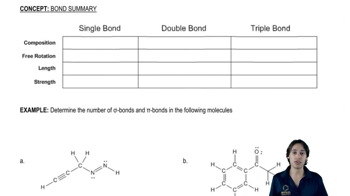
Bond Length
Bond length is the distance between the nuclei of two bonded atoms. It is influenced by the type of bond (single, double, or triple) and the atoms involved. Generally, single bonds are longer than double bonds due to the increased electron density between the bonded atoms in double bonds, which pulls them closer together.
Recommended video:
Guided course
Single bonds, double bonds, and triple bonds.
Resonance in Benzene
Benzene is a cyclic compound with alternating single and double bonds, but it exhibits resonance. This means that the actual structure is a hybrid of multiple contributing structures, leading to equal bond lengths throughout the ring. The delocalization of electrons in benzene results in bond lengths that are intermediate between single and double bonds.
Recommended video:
Guided course
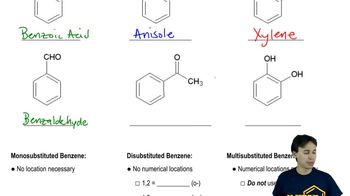
Benzene Nomenclature
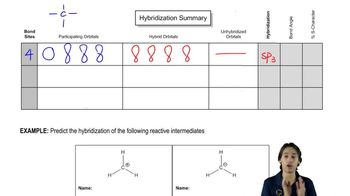
Hybridization
Hybridization is the concept of mixing atomic orbitals to form new hybrid orbitals that can accommodate bonding. In benzene, the carbon atoms undergo sp² hybridization, resulting in three sp² hybrid orbitals for sigma bonding and one unhybridized p orbital for pi bonding. This hybridization contributes to the equal bond lengths observed in benzene.
Recommended video:
Guided course
Using bond sites to predict hybridization
Related Practice
Textbook Question
1083
views
Textbook Question
Between pyrrole and pyrrolidine, which nitrogen would be most nucleophilic? Why?
1335
views
Textbook Question
If Kekulé's original hypothesis had been correct and benzene was really an equilibrium between two structures, how many distinct isomers would exist for 1,2-dichlorobenzene?
1176
views
Textbook Question
Suggest an arrow-pushing mechanism that accounts for the formation of the following Lewis acid–Lewis base complexes. Label the Lewis acid and Lewis base in each.
(b)
702
views
Textbook Question
Suggest an arrow-pushing mechanism that accounts for the formation of the following Lewis acid–Lewis base complexes. Label the Lewis acid and Lewis base in each.
(a)
1079
views
Textbook Question
Draw resonance structures to identify which of the following is the more stable carbocation.
1097
views