Ch. 8 - Alkenes I: Properties and Electrophilic Additions
Mullins - Organic Chemistry: A Learner Centered Approach 1st Edition
Mullins1st EditionOrganic Chemistry: A Learner Centered ApproachISBN: 9780137566471Not the one you use?Change textbook
Chapter 7, Problem 54b(ii)

Predict the products you would get when the following alkenes undergo (ii) oxymercuration–reduction [1. Hg(OAc)2 , H2O 2. NaBH4 ].
(b) Chemical structure of an octagonal alkene with a double bond indicated, used for predicting reaction products.

Verified step by step guidance
1
Step 1: Identify the alkene structure in the given image. The structure is a cyclodecene, a cyclic compound with a double bond in a 10-membered ring.
Step 2: Recall the mechanism of oxymercuration-reduction. In the first step, Hg(OAc)2 and H2O are used to add a hydroxyl group (-OH) to the more substituted carbon of the double bond, following Markovnikov's rule. This avoids carbocation rearrangements.
Step 3: Understand that the addition of the hydroxyl group occurs without stereoselectivity in the first step. The intermediate formed is an organomercury compound.
Step 4: In the second step, NaBH4 is used to reduce the organomercury intermediate, replacing the mercury group with a hydrogen atom. This completes the formation of the alcohol product.
Step 5: Predict the final product. The double bond in cyclodecene will be converted into an alcohol group (-OH) attached to the more substituted carbon of the original double bond, resulting in a Markovnikov alcohol product.

Verified video answer for a similar problem:

This video solution was recommended by our tutors as helpful for the problem above.
Video duration:
2m
Was this helpful?

Key Concepts

Here are the essential concepts you must grasp in order to answer the question correctly.

Oxymercuration-Reduction

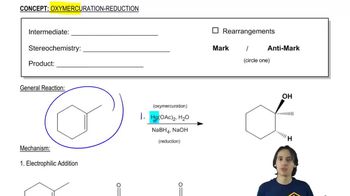
Oxymercuration-reduction is a two-step reaction used to convert alkenes into alcohols. The first step involves the addition of mercuric acetate (Hg(OAc)2) and water to the alkene, forming a mercurial intermediate. In the second step, sodium borohydride (NaBH4) is used to reduce the mercurial compound to an alcohol, resulting in Markovnikov addition of water across the double bond.
Recommended video:
Guided course
05:
General properties of oxymercuration-reduction.

Markovnikov's Rule

Markovnikov's Rule states that when HX (where X is a halogen or OH) is added to an asymmetric alkene, the hydrogen atom will attach to the carbon with the greater number of hydrogen atoms already attached. This rule helps predict the major product of electrophilic addition reactions, ensuring that the more stable carbocation intermediate is formed during the reaction.
Recommended video:
Guided course
03:54
The 18 and 16 Electron Rule

Alkene Reactivity

Alkenes are reactive due to the presence of a carbon-carbon double bond, which is a site of high electron density. This reactivity allows alkenes to undergo various addition reactions, including electrophilic additions like oxymercuration. The structure and substitution pattern of the alkene influence the reaction pathway and the stability of intermediates, which are crucial for predicting the products formed.
Recommended video:
2:09
Alkene Metathesis Concept 1