Ch. 6 - Stereoisomerism: Arrangement of Atoms in Space
Mullins - Organic Chemistry: A Learner Centered Approach 1st Edition
Mullins1st EditionOrganic Chemistry: A Learner Centered ApproachISBN: 9780137566471Not the one you use?Change textbook
Chapter 5, Problem 45a

We discuss the reaction of Grignard reagents (organomagnesium compounds) to ketones in Chapter 17. Mechanistically, the reaction proceeds by the nucleophilic addition of a methyl carbanion to the electrophilic carbon of the carbonyl, breaking the C―Oπ bond, resulting in an alkoxide intermediate that is subsequently protonated to produce the 3° alcohol.
(a) Why does this reaction produce a racemic mixture of 3° alcohols?
Grignard reaction with ketone forms racemic 3° alcohols, 80% major and 20% minor stereoisomers shown.

Verified step by step guidance
1
Understand the concept of a Grignard reagent: Grignard reagents are organomagnesium compounds, typically represented as RMgX, where R is an organic group and X is a halogen. They are highly nucleophilic and react with electrophilic centers such as carbonyl groups.
Recognize the nature of the carbonyl group: The carbonyl group (C=O) in ketones is electrophilic due to the polarization of the C=O bond, where the carbon atom is partially positive and the oxygen atom is partially negative.
Identify the nucleophilic attack: In the reaction, the Grignard reagent provides a methyl carbanion (CH₃⁻) that attacks the electrophilic carbon of the carbonyl group, breaking the C=O π bond and forming a new C-C bond.
Consider the formation of the alkoxide intermediate: The nucleophilic attack results in an alkoxide intermediate, which is a negatively charged oxygen species. This intermediate is planar and can be attacked from either side, leading to the formation of two enantiomers.
Explain the formation of a racemic mixture: Since the alkoxide intermediate is planar, the subsequent protonation step can occur from either side, resulting in equal probability of forming both enantiomers of the 3° alcohol. This leads to a racemic mixture, which is a 50:50 mixture of two enantiomers.

Verified video answer for a similar problem:

This video solution was recommended by our tutors as helpful for the problem above.
Was this helpful?

Key Concepts

Here are the essential concepts you must grasp in order to answer the question correctly.

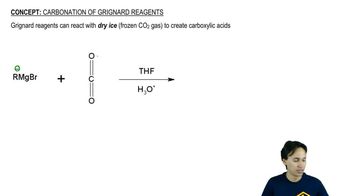
Grignard Reagents

Grignard reagents are organomagnesium compounds used in organic synthesis to form carbon-carbon bonds. They are highly nucleophilic, allowing them to attack electrophilic centers such as carbonyl groups in ketones, leading to the formation of alcohols. The reactivity of Grignard reagents is crucial for understanding their role in the nucleophilic addition mechanism.
Recommended video:
Guided course
02:12
Carbonation of Grignard Reagents

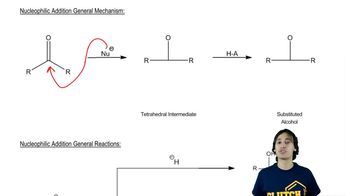
Nucleophilic Addition Mechanism

Nucleophilic addition involves the attack of a nucleophile, such as a methyl carbanion from a Grignard reagent, on an electrophilic center, like the carbonyl carbon in ketones. This process breaks the C―Oπ bond, forming an alkoxide intermediate. Understanding this mechanism is essential for predicting the outcome of reactions involving Grignard reagents and carbonyl compounds.
Recommended video:
Guided course
08:27
Nucleophilic Addition

Racemic Mixture Formation

A racemic mixture consists of equal amounts of two enantiomers, which are mirror-image isomers. In the context of Grignard reactions with ketones, the planar nature of the carbonyl group allows the nucleophilic attack to occur from either side, leading to the formation of both enantiomers of the 3° alcohol. This symmetry results in a racemic mixture, which is key to understanding the stereochemical outcome of the reaction.
Recommended video:
Guided course
02:26
Formation of Enolates