Ch. 6 - Stereoisomerism: Arrangement of Atoms in Space
Mullins - Organic Chemistry: A Learner Centered Approach 1st Edition
Mullins1st EditionOrganic Chemistry: A Learner Centered ApproachISBN: 9780137566471Not the one you use?Change textbook
Chapter 5, Problem 43

How might you separate enantiomers of 2-phenylpropionic acid?

Verified step by step guidance
1
Step 1: Recognize that enantiomers are non-superimposable mirror images of each other, and they have identical physical properties in achiral environments. To separate them, you need to create a diastereomeric pair, which has different physical properties.
Step 2: React the enantiomers of 2-phenylpropionic acid with a chiral resolving agent, such as a chiral amine (e.g., (R)- or (S)-phenylethylamine). This reaction forms diastereomeric salts.
Step 3: Since diastereomers have different solubilities, recrystallize the diastereomeric salts in an appropriate solvent to separate them based on their differing solubility properties.
Step 4: After separation, hydrolyze the diastereomeric salts to regenerate the original enantiomers of 2-phenylpropionic acid.
Step 5: Confirm the separation of enantiomers using techniques such as polarimetry or chiral chromatography to verify their optical activity and purity.

Verified video answer for a similar problem:

This video solution was recommended by our tutors as helpful for the problem above.
Was this helpful?

Key Concepts

Here are the essential concepts you must grasp in order to answer the question correctly.

Enantiomers

Enantiomers are a type of stereoisomer that are non-superimposable mirror images of each other. They have identical physical properties except for their interaction with polarized light and reactions in chiral environments. Understanding enantiomers is crucial for separating them, as their distinct spatial arrangements lead to different chemical behaviors.
Recommended video:
Guided course
03:23
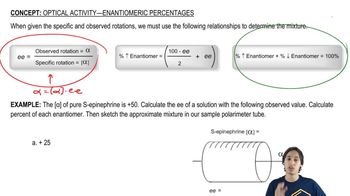
How to solve for the percentage of each enantiomer.

Chirality

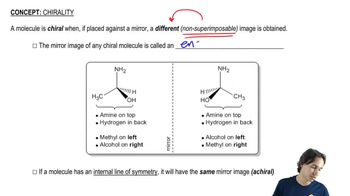
Chirality refers to the property of a molecule that makes it non-superimposable on its mirror image, often due to the presence of a chiral center, typically a carbon atom bonded to four different substituents. This concept is fundamental in organic chemistry, especially in the context of drug design and synthesis, as the different enantiomers can have vastly different biological activities.
Recommended video:
Guided course
05:10
What is chirality?

Resolution of Enantiomers

Resolution of enantiomers is the process of separating a racemic mixture into its individual enantiomers. Techniques such as chiral chromatography, enzymatic resolution, or the use of chiral auxiliaries are commonly employed. Understanding these methods is essential for practical applications in pharmaceuticals and organic synthesis, where the specific enantiomer may be required for desired activity.
Recommended video:
Guided course
03:23
How to solve for the percentage of each enantiomer.