Ethinylestradiol is a synthetic hormone mimic used as a contraceptive for its ability to prevent ovulation. Suggest a mechanism for the synthesis using sodium acetylide and estrone, followed by quenching with acid.
Ch. 10 - Alkynes: Electrophilic Addition and Redox Reactions

Mullins1st EditionOrganic Chemistry: A Learner Centered ApproachISBN: 9780137566471Not the one you use?Change textbook
All textbooks
Mullins 1st Edition
Ch. 10 - Alkynes: Electrophilic Addition and Redox Reactions
Problem 61
Mullins 1st Edition
Ch. 10 - Alkynes: Electrophilic Addition and Redox Reactions
Problem 61Chapter 9, Problem 61
An alternate method for the synthesis of alkynes relies on the double elimination of H―Br from a dihaloalkane under basic conditions. Suggest a mechanism for this reaction that we discuss in Chapter 12.

Verified step by step guidance1
Step 1: Begin by identifying the starting material, which is a dihaloalkane. A dihaloalkane contains two halogen atoms (e.g., bromine) attached to adjacent carbon atoms in the molecule.
Step 2: Recognize that the reaction occurs under basic conditions. A strong base, such as NaNH₂ or KOH, is typically used to facilitate the elimination process. The base will abstract a proton (H⁺) from the molecule.
Step 3: In the first elimination step, the base abstracts a proton from a carbon atom adjacent to one of the halogen atoms. This leads to the formation of a carbanion intermediate. The halogen atom (e.g., Br) leaves as a halide ion (Br⁻), resulting in the formation of a double bond (alkene).
Step 4: In the second elimination step, the base abstracts another proton from the carbon atom adjacent to the remaining halogen atom. This leads to the formation of another carbanion intermediate. The second halogen atom leaves as a halide ion, resulting in the formation of a triple bond (alkyne).
Step 5: The final product is an alkyne, formed after the double elimination of H―Br from the dihaloalkane. The reaction mechanism involves two consecutive E2 elimination steps, where the base facilitates the removal of protons and halide ions to form the alkyne.

Verified video answer for a similar problem:
This video solution was recommended by our tutors as helpful for the problem above.
Video duration:
1mWas this helpful?
Key Concepts
Here are the essential concepts you must grasp in order to answer the question correctly.
Alkynes and Their Synthesis
Alkynes are hydrocarbons containing at least one carbon-carbon triple bond. They can be synthesized through various methods, including the double elimination of hydrogen halides from dihaloalkanes. Understanding the structure and reactivity of alkynes is crucial for predicting the outcomes of synthetic reactions.
Recommended video:
Guided course
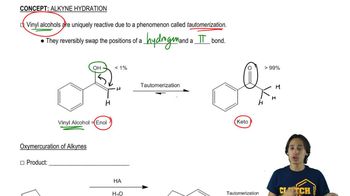
Alkyne Hydration
Dihaloalkanes
Dihaloalkanes are organic compounds that contain two halogen atoms attached to a carbon chain. Their reactivity is influenced by the nature of the halogens and the surrounding conditions. In the context of alkyne synthesis, the elimination of H-Br from a dihaloalkane is a key step that requires a strong base to facilitate the reaction.
Elimination Reactions
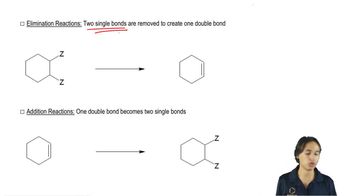
Elimination reactions involve the removal of atoms or groups from a molecule, resulting in the formation of a double or triple bond. In this case, the double elimination of H-Br from a dihaloalkane leads to the formation of an alkyne. Understanding the mechanism of elimination reactions, including the role of bases and the formation of intermediates, is essential for predicting reaction pathways.
Recommended video:
Guided course
Recognizing Elimination Reactions.
Related Practice
Textbook Question
982
views
Textbook Question
In 1973, Caine and Tuller reported a synthesis of racemic oplapanone, a sesquiterpene isolated from Oplopanax japonicus (a deciduous shrub) involving a reaction we learned in this chapter. Predict the product of the reaction shown. (Caine, D.; Tuller, F. N. J. Org. Chem. 1973, 38, 3663.)
997
views
Textbook Question
A chemist attempted to do the following acetylide alkylation reaction but was unsuccessful in several attempts, producing only the original starting materials in each case. Explain why the reaction didn't work.
952
views
Textbook Question
When alkynes are treated with water and bromine a bromoketone is produced. Provide a plausible arrow-pushing mechanism that accounts for the formation of this product.
1431
views