Ch. 10 - Alkynes: Electrophilic Addition and Redox Reactions
Mullins - Organic Chemistry: A Learner Centered Approach 1st Edition
Mullins1st EditionOrganic Chemistry: A Learner Centered ApproachISBN: 9780137566471Not the one you use?Change textbook
Chapter 9, Problem 62

Ethinylestradiol is a synthetic hormone mimic used as a contraceptive for its ability to prevent ovulation. Suggest a mechanism for the synthesis using sodium acetylide and estrone, followed by quenching with acid.
Synthesis mechanism diagram showing sodium acetylide reacting with estrone, followed by acid quenching to form ethinylestradiol.

Verified step by step guidance
1
Step 1: Recognize the key reactants and their roles. Estrone is a ketone-containing compound, and sodium acetylide (NaC≡CH) is a strong nucleophile due to the negatively charged acetylide ion. The acetylide ion can attack electrophilic centers, such as the carbonyl group in estrone.
Step 2: Identify the first step of the mechanism. The acetylide ion will perform a nucleophilic attack on the carbonyl carbon of estrone. This occurs because the carbonyl carbon is electrophilic due to the partial positive charge created by the oxygen atom's electronegativity. Represent this step as: Estrone + NaC≡CH → Intermediate (alkoxide).
Step 3: Describe the formation of the intermediate. The nucleophilic attack results in the formation of an alkoxide intermediate, where the oxygen atom from the carbonyl group now carries a negative charge. This intermediate is stabilized by resonance within the molecule.
Step 4: Explain the quenching step. The alkoxide intermediate is quenched with acid (e.g., HCl or H₂SO₄), which protonates the negatively charged oxygen atom, converting it into a hydroxyl group. This step completes the synthesis of the desired product.
Step 5: Highlight the final product. The reaction results in the formation of ethinylestradiol, where the acetylide group has been added to the estrone structure, and the carbonyl group has been converted into a hydroxyl group. This product is a synthetic hormone mimic used in contraceptives.

Verified video answer for a similar problem:

This video solution was recommended by our tutors as helpful for the problem above.
Video duration:
3m
Was this helpful?

Key Concepts

Here are the essential concepts you must grasp in order to answer the question correctly.

Sodium Acetylide as a Nucleophile

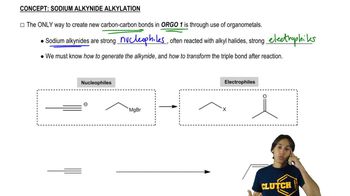
Sodium acetylide is a strong nucleophile due to the presence of a negatively charged carbon atom. In organic synthesis, it can attack electrophilic centers, such as carbonyl groups, facilitating the formation of new carbon-carbon bonds. This property is crucial in the synthesis of complex molecules, including hormone mimics like ethinylestradiol.
Recommended video:
Guided course
03:19
Sodium Alkynide Alkylation

Carbonyl Chemistry

Carbonyl compounds, such as ketones and aldehydes, are characterized by a carbon-oxygen double bond. They are key intermediates in organic reactions, particularly in nucleophilic addition reactions. Understanding how nucleophiles like sodium acetylide interact with carbonyl groups is essential for proposing a synthesis mechanism involving estrone.
Recommended video:
Guided course
04:20
Carboxylic Acids Nomenclature

Quenching with Acid

Quenching with acid is a common step in organic synthesis that involves adding an acid to neutralize a reaction mixture, often to protonate reactive intermediates. This step can stabilize the product and facilitate the removal of byproducts. In the context of synthesizing ethinylestradiol, acid quenching would help finalize the reaction and yield the desired hormone mimic.
Recommended video:
Guided course
02:23
Using factors affecting acidity to rank acids