Ch. 11 - Properties and Synthesis of Alkyl Halides: Radical Reactions
Mullins - Organic Chemistry: A Learner Centered Approach 1st Edition
Mullins1st EditionOrganic Chemistry: A Learner Centered ApproachISBN: 9780137566471Not the one you use?Change textbook
Chapter 10, Problem 51d

For the following reaction, answer questions (a)–(d).
Chemical reaction: square A plus Br2 under heat yields square with two Br atoms attached.
(d) Given your choice in (b), why is it the weakest bond?

Verified step by step guidance
1
Step 1: Identify the reaction type and the bonds involved. Consider the types of bonds present in the reactants and products, such as single, double, or triple bonds.
Step 2: Review the concept of bond strength. Bond strength is generally related to the bond order; higher bond orders (e.g., triple bonds) are stronger than lower bond orders (e.g., single bonds).
Step 3: Consider the electronegativity of the atoms involved in the bond. Bonds between atoms with similar electronegativity tend to be weaker than those between atoms with differing electronegativity.
Step 4: Analyze the bond length. Longer bonds are typically weaker than shorter bonds. Bond length is influenced by the size of the atoms and the bond order.
Step 5: Evaluate the bond energy. The weakest bond will have the lowest bond energy, which is the energy required to break the bond. Compare the bond energies of the bonds involved in the reaction.

Verified video answer for a similar problem:

This video solution was recommended by our tutors as helpful for the problem above.
Video duration:
3m
Was this helpful?

Key Concepts

Here are the essential concepts you must grasp in order to answer the question correctly.

Bond Strength

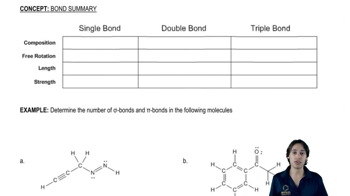
Bond strength refers to the energy required to break a bond between two atoms. It is influenced by factors such as bond length, bond order, and the electronegativity of the atoms involved. Generally, shorter bonds with higher bond orders are stronger, while longer bonds with lower bond orders are weaker.
Recommended video:
Guided course
06:00
Single bonds, double bonds, and triple bonds.

Electronegativity

Electronegativity is a measure of an atom's ability to attract and hold onto electrons within a chemical bond. Differences in electronegativity between bonded atoms can affect bond polarity and strength. Bonds between atoms with similar electronegativities tend to be weaker due to less polar character.
Recommended video:
Guided course
1:47
Electronegativity

Bond Length

Bond length is the average distance between the nuclei of two bonded atoms. It is determined by the size of the atoms and the type of bond (single, double, or triple). Longer bond lengths generally correlate with weaker bonds, as the overlap between atomic orbitals is reduced, leading to less effective electron sharing.
Recommended video:
Guided course
06:00
Single bonds, double bonds, and triple bonds.