The following ethers are ranked according to their ability to form explosive peroxides. Explain this ranking based on your knowledge of the reaction mechanism.
Ch. 11 - Properties and Synthesis of Alkyl Halides: Radical Reactions

Mullins1st EditionOrganic Chemistry: A Learner Centered ApproachISBN: 9780137566471Not the one you use?Change textbook
All textbooks
Mullins 1st Edition
Ch. 11 - Properties and Synthesis of Alkyl Halides: Radical Reactions
Problem 52a
Mullins 1st Edition
Ch. 11 - Properties and Synthesis of Alkyl Halides: Radical Reactions
Problem 52aChapter 10, Problem 52a
Provide the mechanism of the radical reactions shown.
(a) 
Verified step by step guidance1
Identify the type of radical reaction: Radical reactions typically involve initiation, propagation, and termination steps. Determine which type of radical reaction is being asked about, such as halogenation, polymerization, or another type.
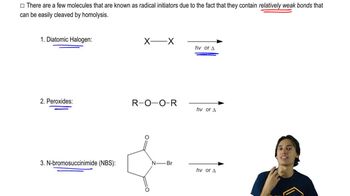
Initiation step: In this step, radicals are generated. This often involves the homolytic cleavage of a bond, usually facilitated by heat or light. For example, in halogenation, a diatomic halogen molecule (e.g., Cl2) is split into two halogen radicals.
Propagation steps: These steps involve the radicals reacting with stable molecules to form new radicals. For example, in a halogenation reaction, a halogen radical might react with a hydrocarbon to form a new radical and a hydrogen halide.
Termination steps: In these steps, radicals combine to form stable molecules, effectively ending the chain reaction. This could involve two radicals combining to form a stable molecule, such as two halogen radicals forming a diatomic halogen molecule.
Draw the mechanism: Use curved arrows to show the movement of electrons in each step of the mechanism. Ensure that each step is balanced in terms of radicals and that the overall reaction is consistent with the type of radical reaction identified in step 1.

Verified video answer for a similar problem:
This video solution was recommended by our tutors as helpful for the problem above.
Video duration:
8mWas this helpful?
Key Concepts
Here are the essential concepts you must grasp in order to answer the question correctly.
Radical Reactions
Radical reactions involve species with unpaired electrons, known as radicals. These reactions typically proceed through three stages: initiation, where radicals are generated; propagation, where radicals react with stable molecules to form new radicals; and termination, where radicals combine to form stable products. Understanding these stages is crucial for predicting the course of a radical reaction.
Recommended video:
Guided course
What are Radical Initiators?
Initiation Step
The initiation step in radical reactions is the process by which radicals are first formed, often through the homolytic cleavage of a bond. This can be achieved using heat, light, or chemical initiators. For example, the homolytic cleavage of a chlorine molecule (Cl2) under UV light produces two chlorine radicals, which can then participate in further reactions.
Recommended video:
Step-Growth Polymers Concept 1
Propagation Step
During the propagation step, radicals generated in the initiation step react with stable molecules to form new radicals, perpetuating the reaction cycle. This step is crucial as it determines the chain reaction nature of radical processes. For instance, a chlorine radical can react with methane to form hydrochloric acid and a methyl radical, which can further react with another chlorine molecule.
Recommended video:
Step-Growth Polymers Concept 1
Related Practice
Textbook Question
995
views
Textbook Question
For the following reaction, answer questions (a)–(d).
(d) Given your choice in (b), why is it the weakest bond?
1100
views
Textbook Question
Provide the mechanism of the radical reactions shown.
(b)
1182
views
Textbook Question
For the following reaction, answer questions (a)–(d).
(b) Which is the weakest bond in molecule A?
1082
views
Textbook Question
For the following reaction, answer questions (a)–(d).
(a) Give an arrow-pushing mechanism, including the initiation step and two propagation steps.
1095
views
Textbook Question
One danger associated with storing ether solvents is their tendency to form explosive peroxides when exposed to oxygen. Suggest a mechanism by which the hydroperoxide might form. You can assume the presence of X• to start the reaction.
1245
views