Ch. 11 - Properties and Synthesis of Alkyl Halides: Radical Reactions
Mullins - Organic Chemistry: A Learner Centered Approach 1st Edition
Mullins1st EditionOrganic Chemistry: A Learner Centered ApproachISBN: 9780137566471Not the one you use?Change textbook
Chapter 10, Problem 20a

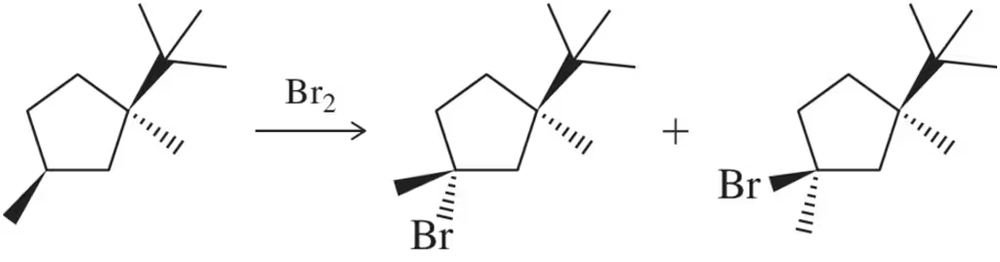
When (1R,3S)-1-tert-butyl-1,3-dimethylcyclopentane is halogenated, one stereoisomer is produced in excess.
(a) Predict the identity of the major stereoisomer
Chemical reaction showing bromination of 1-tert-butyl-1,3-dimethylcyclopentane, producing two stereoisomers.

Verified step by step guidance
1
Identify the structure of (1R,3S)-1-tert-butyl-1,3-dimethylcyclopentane. The cyclopentane ring has a tert-butyl group at position 1 and a methyl group at position 3. The stereochemistry is specified as 1R and 3S.
Consider the mechanism of halogenation. Halogenation typically occurs via a radical mechanism, which involves the formation of a radical intermediate.
Determine the most stable radical intermediate. In this case, the radical will likely form at the most substituted carbon, which is the tertiary carbon at position 1 due to the presence of the tert-butyl group.
Predict the stereochemistry of the product. The radical intermediate can lead to the formation of a new chiral center. The major product will be the one where the new substituent (halogen) is added in a way that minimizes steric hindrance and stabilizes the transition state.
Conclude which stereoisomer is produced in excess. The major stereoisomer will be the one where the halogen is added to the less hindered face of the radical intermediate, considering the original stereochemistry of the molecule.

Verified video answer for a similar problem:

This video solution was recommended by our tutors as helpful for the problem above.
Video duration:
6m
Was this helpful?

Key Concepts

Here are the essential concepts you must grasp in order to answer the question correctly.

Stereochemistry

Stereochemistry involves the study of the spatial arrangement of atoms in molecules and its impact on chemical reactions. In organic chemistry, understanding stereochemistry is crucial for predicting the behavior and properties of stereoisomers, which are molecules with the same molecular formula but different three-dimensional configurations.
Recommended video:
1:38
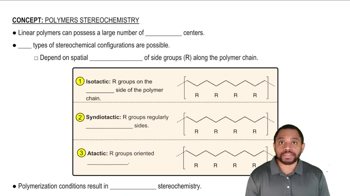
Polymer Stereochemistry Concept 1

Chirality and Enantiomers

Chirality refers to the property of a molecule having non-superimposable mirror images, known as enantiomers. Each chiral center in a molecule can exist in two configurations, R or S, which affects the molecule's interaction with other chiral entities. Identifying the configuration of chiral centers is essential for predicting the stereochemical outcome of reactions.
Recommended video:
Guided course
05:10
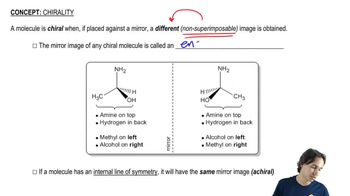
What is chirality?

Halogenation Reaction Mechanism

Halogenation is a chemical reaction where a halogen atom is introduced into a molecule, often resulting in the formation of new stereoisomers. The mechanism typically involves the formation of a carbocation intermediate, which can lead to rearrangements or preferential formation of certain stereoisomers based on stability and steric factors.
Recommended video:
Guided course
03:45
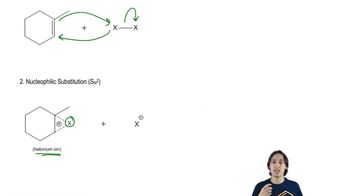
Halogenation Mechanism