Ch. 11 - Properties and Synthesis of Alkyl Halides: Radical Reactions
Mullins - Organic Chemistry: A Learner Centered Approach 1st Edition
Mullins1st EditionOrganic Chemistry: A Learner Centered ApproachISBN: 9780137566471Not the one you use?Change textbook
Chapter 10, Problem 20b

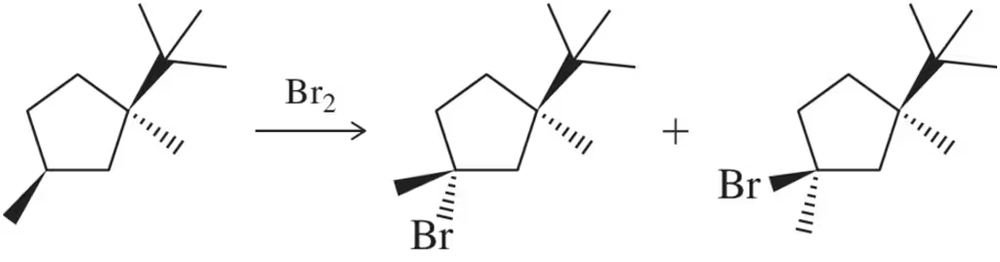
When (1R,3S)-1-tert-butyl-1,3-dimethylcyclopentane is halogenated, one stereoisomer is produced in excess.
(b) explain why this reaction did not produce an equal mixture of stereoisomers.
Chemical reaction showing bromination of 1-tert-butyl-1,3-dimethylcyclopentane, producing two stereoisomers.

Verified step by step guidance
1
Identify the type of reaction: Halogenation of alkanes typically proceeds via a radical mechanism, which involves the formation of a radical intermediate.
Consider the stereochemistry: The starting material, (1R,3S)-1-tert-butyl-1,3-dimethylcyclopentane, has chiral centers. The reaction can lead to the formation of different stereoisomers depending on the radical intermediate's stability and the approach of the halogen.
Analyze the radical stability: In radical halogenation, the most stable radical intermediate is favored. The tertiary radical at the 1-position (where the tert-butyl group is attached) is more stable than a secondary or primary radical due to hyperconjugation and inductive effects.
Predict the major product: The formation of the more stable radical intermediate leads to a preference for one stereoisomer over others. The major product will be the one where the halogen adds to the most stable radical, maintaining the configuration at the other chiral center.
Explain the excess of one stereoisomer: The reaction does not produce an equal mixture of stereoisomers because the formation of the more stable radical intermediate is favored, leading to a predominant formation of one stereoisomer over the others.

Verified video answer for a similar problem:

This video solution was recommended by our tutors as helpful for the problem above.
Video duration:
5m
Was this helpful?

Key Concepts

Here are the essential concepts you must grasp in order to answer the question correctly.

Stereochemistry

Stereochemistry involves the study of the spatial arrangement of atoms in molecules and its impact on chemical reactions. In this context, understanding the stereochemistry of (1R,3S)-1-tert-butyl-1,3-dimethylcyclopentane is crucial, as the configuration of its chiral centers influences the formation of specific stereoisomers during halogenation.
Recommended video:
1:38
Polymer Stereochemistry Concept 1

Chiral Centers

Chiral centers are atoms in a molecule that have four different substituents, leading to non-superimposable mirror images called enantiomers. The presence of chiral centers in (1R,3S)-1-tert-butyl-1,3-dimethylcyclopentane results in stereoisomers, and the reaction conditions can favor the formation of one stereoisomer over another due to steric and electronic effects.
Recommended video:
Guided course
05:41
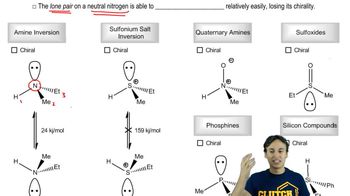
Understanding Other Chiral Atoms

Reaction Mechanism

The reaction mechanism describes the step-by-step process by which reactants are transformed into products. In halogenation, factors such as steric hindrance and electronic effects can influence the pathway, leading to the preferential formation of one stereoisomer. Understanding the mechanism helps explain why an unequal mixture of stereoisomers is produced.
Recommended video:
Guided course
02:16
Heck Reaction Mechanism