Ch. 12 - Substitution and Elimination: Reactions of Haloalkanes
Mullins - Organic Chemistry: A Learner Centered Approach 1st Edition
Mullins1st EditionOrganic Chemistry: A Learner Centered ApproachISBN: 9780137566471Not the one you use?Change textbook
Chapter 11, Problem 18b

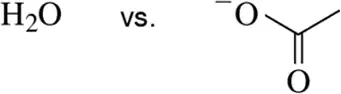
For each pair, choose the more reactive nucleophile.
(b) Comparison of water (H2O) and a negatively charged oxygen species in a nucleophile reactivity context.

Verified step by step guidance
1
Step 1: Understand the concept of nucleophilicity. Nucleophilicity refers to the ability of a species to donate a pair of electrons to an electrophile. It is influenced by factors such as charge, electronegativity, steric hindrance, and solvent effects.
Step 2: Analyze the chemical structures provided. The first species is water (H₂O), which is neutral, and the second species is the acetate ion (CH₃COO⁻), which is negatively charged.
Step 3: Consider the effect of charge on nucleophilicity. Negatively charged species are generally more nucleophilic than neutral species because they have a higher electron density available for donation.
Step 4: Evaluate the role of resonance in the acetate ion. The acetate ion has resonance stabilization, which slightly delocalizes its negative charge. While this reduces its nucleophilicity compared to a localized negative charge, it is still more nucleophilic than neutral water.
Step 5: Compare the two species. Water is neutral and less nucleophilic, while the acetate ion is negatively charged and more nucleophilic despite resonance stabilization. Therefore, the acetate ion is the more reactive nucleophile in this pair.

Verified video answer for a similar problem:

This video solution was recommended by our tutors as helpful for the problem above.
Video duration:
58s
Was this helpful?

Key Concepts

Here are the essential concepts you must grasp in order to answer the question correctly.

Nucleophilicity

Nucleophilicity refers to the ability of a species to donate an electron pair to an electrophile during a chemical reaction. It is influenced by factors such as charge, electronegativity, and steric hindrance. Generally, negatively charged species are more nucleophilic than their neutral counterparts, and less sterically hindered nucleophiles are more reactive.
Recommended video:
Guided course
08:27
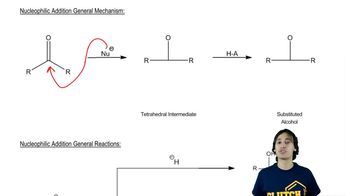
Nucleophilic Addition

Solvent Effects

The solvent can significantly affect nucleophilicity. In polar protic solvents, nucleophiles are often stabilized by solvation, which can reduce their reactivity. Conversely, in polar aprotic solvents, nucleophiles are less solvated and thus more reactive. Understanding the solvent's role is crucial when comparing the reactivity of nucleophiles.
Recommended video:
Guided course
01:16
Identification of polarity in solvents

Electrophilicity

Electrophilicity is the tendency of a species to accept electrons. It is a key factor in nucleophilic substitution reactions, as a more electrophilic center will react more readily with nucleophiles. The strength of the electrophile can influence the overall reaction rate and the choice of nucleophile in a given reaction.
Recommended video:
Guided course
03:
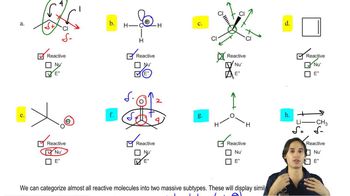
Nucleophile or Electrophile