Ch. 12 - Substitution and Elimination: Reactions of Haloalkanes
Mullins - Organic Chemistry: A Learner Centered Approach 1st Edition
Mullins1st EditionOrganic Chemistry: A Learner Centered ApproachISBN: 9780137566471Not the one you use?Change textbook
Chapter 11, Problem 19

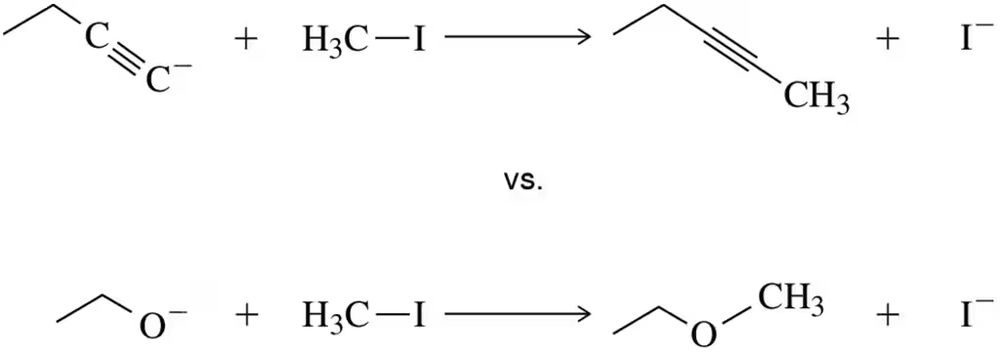
Which SN2 reaction would you expect to be faster? Explain your answer.
Comparison of two SN2 reactions with structures and products, highlighting differences in reaction speed.

Verified step by step guidance
1
Step 1: Understand the Sₙ2 reaction mechanism. The Sₙ2 reaction is a bimolecular nucleophilic substitution reaction where the nucleophile attacks the electrophilic carbon in a single, concerted step. The rate of the reaction depends on factors such as steric hindrance, the strength of the nucleophile, and the leaving group.
Step 2: Analyze steric hindrance. In an Sₙ2 reaction, steric hindrance around the electrophilic carbon significantly affects the reaction rate. A less hindered (less crowded) carbon allows the nucleophile to approach more easily, leading to a faster reaction.
Step 3: Evaluate the nucleophile. The strength and concentration of the nucleophile can influence the reaction rate. A stronger nucleophile will react more quickly in an Sₙ2 mechanism.
Step 4: Consider the leaving group. A good leaving group stabilizes the negative charge after departure, facilitating the reaction. Compare the leaving groups in the given reactions to determine which one is better.
Step 5: Compare the two reactions. Based on steric hindrance, nucleophile strength, and leaving group quality, determine which reaction has the conditions that favor a faster Sₙ2 mechanism. The reaction with less steric hindrance and a better leaving group will typically proceed faster.

Verified video answer for a similar problem:

This video solution was recommended by our tutors as helpful for the problem above.
Video duration:
4m
Was this helpful?

Key Concepts

Here are the essential concepts you must grasp in order to answer the question correctly.

Sₙ2 Reaction Mechanism

The Sₙ2 (substitution nucleophilic bimolecular) reaction is a type of nucleophilic substitution where the nucleophile attacks the electrophile simultaneously as the leaving group departs. This concerted mechanism results in a single transition state and is characterized by a second-order reaction rate, dependent on the concentration of both the nucleophile and the substrate.
Recommended video:
Guided course
02:16
Heck Reaction Mechanism

Steric Hindrance

Steric hindrance refers to the prevention of chemical reactions due to the spatial arrangement of atoms within a molecule. In Sₙ2 reactions, increased steric hindrance around the electrophilic carbon can slow down the reaction rate, as bulky groups make it more difficult for the nucleophile to approach and attack the carbon center.
Recommended video:
Guided course
02:53
Understanding steric effects.

Nucleophile Strength

The strength of a nucleophile is a critical factor in Sₙ2 reactions, as it determines how readily the nucleophile can donate its electron pair to form a bond with the electrophile. Stronger nucleophiles, which are often negatively charged or have lone pairs, can enhance the reaction rate, while weaker nucleophiles may lead to slower reactions.
Recommended video:
Guided course
08:27
Nucleophilic Addition