Ch. 12 - Substitution and Elimination: Reactions of Haloalkanes
Mullins - Organic Chemistry: A Learner Centered Approach 1st Edition
Mullins1st EditionOrganic Chemistry: A Learner Centered ApproachISBN: 9780137566471Not the one you use?Change textbook
Chapter 11, Problem 37b

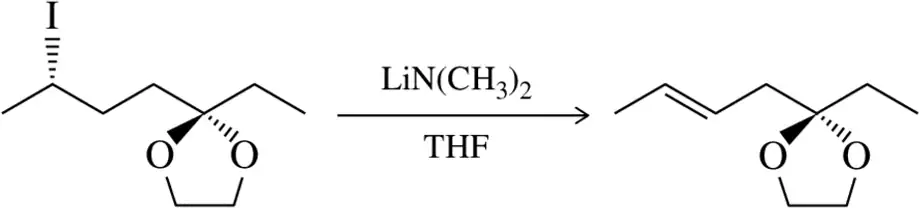
Practice your electron-pushing skills by drawing a mechanism for the following E2 reactions.
(b) Chemical reaction diagram illustrating an E2 elimination mechanism with reactants and products labeled.

Verified step by step guidance
1
Step 1: Identify the reaction type as an E2 elimination reaction. In an E2 reaction, a strong base abstracts a proton from a β-carbon, while a leaving group departs from the α-carbon, resulting in the formation of a double bond.
Step 2: Analyze the structure of the substrate. The molecule contains an iodine atom as the leaving group on the α-carbon and a β-hydrogen on the adjacent carbon. The reaction occurs in the presence of a strong base, LiN(CH₃)₂, in THF solvent.
Step 3: Determine the stereochemical requirements for the E2 reaction. The β-hydrogen and the leaving group (iodine) must be anti-periplanar (i.e., opposite sides of the same plane) to facilitate elimination. Verify that the molecule's conformation allows for this geometry.
Step 4: Electron-pushing mechanism: The base, LiN(CH₃)₂, abstracts the β-hydrogen, forming a bond between the base and the hydrogen. Simultaneously, the electrons from the C-H bond move to form the π-bond of the alkene, while the C-I bond breaks, releasing the iodine as I⁻.
Step 5: Draw the product structure. The resulting molecule has a double bond between the α-carbon and β-carbon, with the iodine removed and the stereochemistry preserved in the remaining groups. Ensure the correct placement of substituents and stereochemistry in the final product.

Verified video answer for a similar problem:

This video solution was recommended by our tutors as helpful for the problem above.
Was this helpful?

Key Concepts

Here are the essential concepts you must grasp in order to answer the question correctly.

E2 Reaction Mechanism

The E2 (bimolecular elimination) reaction is a type of elimination reaction where a base removes a proton from a β-carbon while a leaving group departs from the α-carbon, resulting in the formation of a double bond. This concerted mechanism requires a strong base and typically occurs in a single step, making it essential to understand the stereochemistry and orientation of the reactants for accurate predictions of the product.
Recommended video:
Guided course
09:36
Drawing the E2 Mechanism.

Role of Bases in E2 Reactions

In E2 reactions, strong bases are crucial as they facilitate the removal of a proton from the β-carbon. The choice of base can influence the reaction's rate and the stereochemical outcome. In this case, lithium diisopropylamide (LiN(CH3)2) is a strong, non-nucleophilic base that effectively promotes the elimination process, leading to the formation of alkenes.
Recommended video:
Guided course
00:27
E2 Cumulative Intro

Stereochemistry of Alkenes

The stereochemistry of the resulting alkene in an E2 reaction is determined by the spatial arrangement of the substituents around the double bond. The reaction typically favors the formation of the more stable trans isomer due to steric factors. Understanding the stereochemical implications is vital for predicting the correct product and its properties, especially in reactions involving cyclic structures or substituents that can influence stability.
Recommended video:
1:38
Polymer Stereochemistry Concept 1