Ch. 12 - Substitution and Elimination: Reactions of Haloalkanes
Mullins - Organic Chemistry: A Learner Centered Approach 1st Edition
Mullins1st EditionOrganic Chemistry: A Learner Centered ApproachISBN: 9780137566471Not the one you use?Change textbook
Chapter 11, Problem 35

When 2-bromopropane is treated with sodium ethoxide, propene is produced. What molecule is lost from 2-bromopropane in this process?

Verified step by step guidance
1
Step 1: Recognize the type of reaction occurring. This is an elimination reaction (E2 mechanism), where a molecule is lost from the substrate to form a double bond.
Step 2: Identify the substrate, 2-bromopropane, and note that it contains a bromine atom attached to the second carbon of a propane chain.
Step 3: Understand the role of sodium ethoxide (NaOCH₂CH₃). It acts as a strong base, abstracting a proton (H⁺) from a β-carbon (the carbon adjacent to the carbon bonded to bromine).
Step 4: Determine the molecule lost during the reaction. The bromine atom leaves as a bromide ion (Br⁻), and a proton (H⁺) is abstracted from the β-carbon, resulting in the formation of propene (CH₃-CH=CH₂). The lost molecule is HBr (hydrogen bromide).
Step 5: Summarize the process: Sodium ethoxide facilitates the elimination of HBr from 2-bromopropane, leading to the formation of propene via the E2 mechanism.

Verified video answer for a similar problem:

This video solution was recommended by our tutors as helpful for the problem above.
Video duration:
4m
Was this helpful?

Key Concepts

Here are the essential concepts you must grasp in order to answer the question correctly.

Elimination Reactions

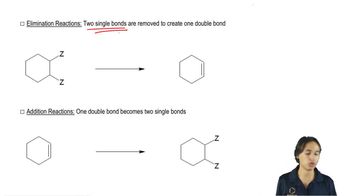
Elimination reactions involve the removal of a small molecule from a larger one, resulting in the formation of a double bond. In the case of 2-bromopropane reacting with sodium ethoxide, an elimination reaction occurs, leading to the formation of propene. Understanding the mechanism of elimination is crucial for predicting the products of such reactions.
Recommended video:
Guided course
00:40
Recognizing Elimination Reactions.

Leaving Groups

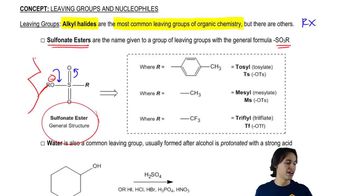
A leaving group is an atom or group that can depart from the parent molecule during a chemical reaction. In the context of 2-bromopropane, the bromine atom acts as a leaving group when the sodium ethoxide facilitates the elimination process. The stability and ability of the leaving group to depart significantly influence the reaction's efficiency.
Recommended video:
Guided course
07:22
The 3 important leaving groups to know.

Base-Induced Elimination

Base-induced elimination refers to the process where a strong base, such as sodium ethoxide, abstracts a proton from a β-carbon, leading to the formation of a double bond. This mechanism is essential in understanding how propene is generated from 2-bromopropane, as the base facilitates the removal of a hydrogen atom alongside the leaving group.
Recommended video:
Guided course
00:38
Intro to Substitution/Elimination Problems