Ch. 13 - Alcohols, Ethers and Related Compounds: Substitution and Elimination
Mullins - Organic Chemistry: A Learner Centered Approach 1st Edition
Mullins1st EditionOrganic Chemistry: A Learner Centered ApproachISBN: 9780137566471Not the one you use?Change textbook
Chapter 12, Problem 96

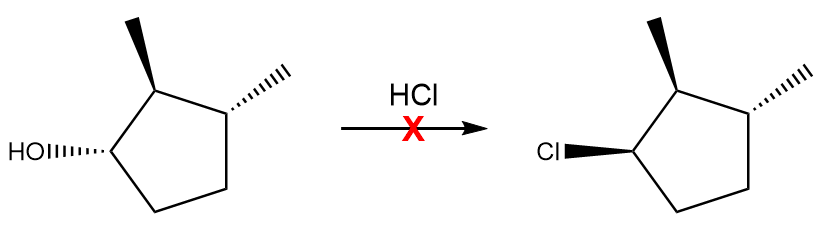
A graduate student attempted the following reaction and did not isolate the expected product.
(a) What product did they isolate?
(b) What reagent should they have used instead to get their desired product?
Reaction diagram showing an alcohol reacting with HCl, resulting in an unexpected product.

Verified step by step guidance
1
Examine the starting material, which is a cyclohexanol with a hydroxyl group (OH) attached to the cyclohexane ring. The hydroxyl group is in the axial position.
Consider the reagent used, HCl, which is typically used for converting alcohols to alkyl chlorides via an SN1 or SN2 mechanism. However, the reaction did not proceed as expected.
Identify the issue with the reaction conditions. The presence of HCl suggests an SN1 mechanism, which requires a stable carbocation intermediate. The cyclohexanol structure may not favor carbocation formation due to steric hindrance or lack of resonance stabilization.
Determine the product that was isolated. Since the expected product was not obtained, the reaction may have led to a rearrangement or an alternative reaction pathway, possibly resulting in a different halogenated compound or no reaction.
Suggest an alternative reagent that could facilitate the desired transformation. Consider using thionyl chloride (SOCl2) or phosphorus tribromide (PBr3) for a more effective conversion of alcohols to alkyl halides, as these reagents can proceed via an SN2 mechanism without requiring carbocation formation.

Verified video answer for a similar problem:

This video solution was recommended by our tutors as helpful for the problem above.
Video duration:
4m
Was this helpful?

Key Concepts

Here are the essential concepts you must grasp in order to answer the question correctly.

Alcohol Reactivity

Alcohols can undergo various reactions, including substitution and elimination. In the presence of strong acids like HCl, alcohols can be converted into alkyl halides through a substitution reaction. Understanding the reactivity of alcohols is crucial for predicting the products of reactions involving them.
Recommended video:
Guided course
01:01
How to name alcohols

Mechanism of Substitution Reactions

Substitution reactions can occur via two main mechanisms: SN1 and SN2. SN1 involves the formation of a carbocation intermediate, while SN2 is a one-step process where the nucleophile attacks the substrate simultaneously as the leaving group departs. The choice of mechanism affects the product formed and is essential for determining the expected outcome of the reaction.
Recommended video:
Guided course
01:34
Recognizing Substitution Reactions.

Reagent Selection

The choice of reagent can significantly influence the reaction pathway and the product obtained. In this case, using HCl may lead to unexpected products due to competing reactions or rearrangements. Understanding which reagents promote desired reactions is vital for achieving specific synthetic goals in organic chemistry.
Recommended video: